|
$$PLAIN_TEXT_PREVIEW$$
|
Please forward this newsletter to family members, friends and acquaintances you think might be supportive of our aims to return the National Trust to its statutory aims and charitable ethos, and encourage them to sign up to Restore Trust’s regular newsletter for our latest updates. Together we can restore trust in the National Trust.
|
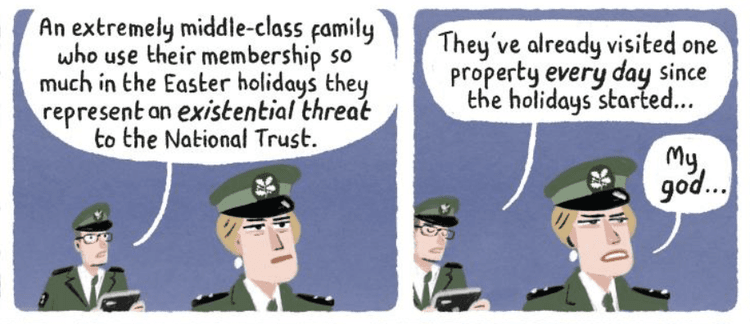
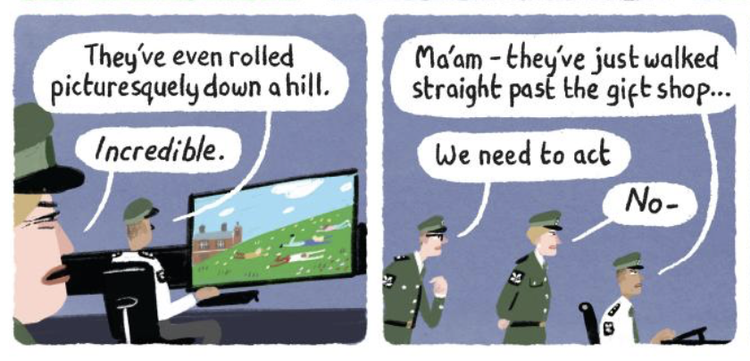
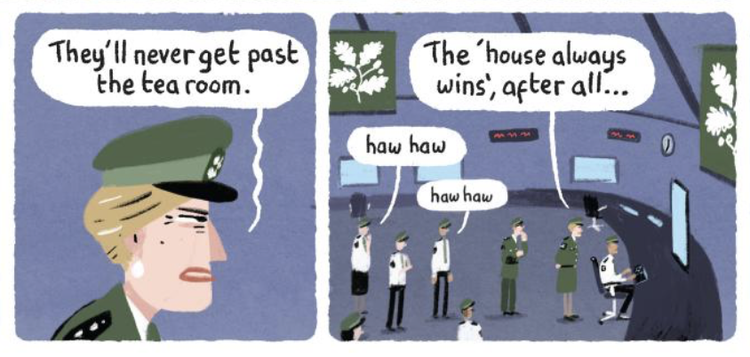
GUARDIAN CARTOON POKES FUN AT NT MANAGEMENT
|
|
A cartoon (below) by Stephen Collins for the Guardian, published on 31 March, makes a serious point about the way in which the current National Trust management views its membership.
|
RESTORE TRUST CHAIR AND DIRECTOR INTERVIEWED
|
|
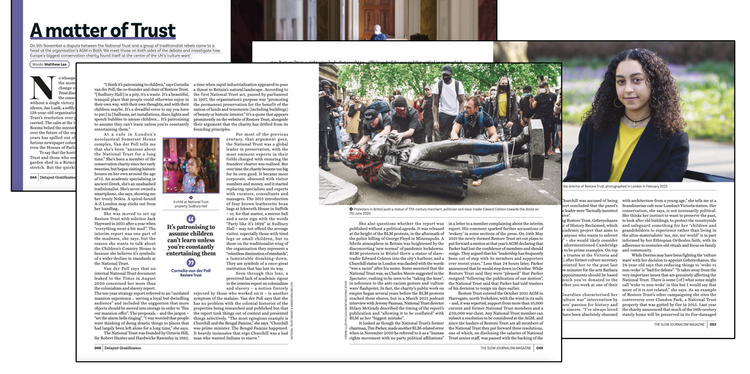
Below are brief extracts from the article ‘A Matter of Trust’ by Matthew Lee which commanded a 12-page spread in the latest edition of award-winning ‘slow news’ magazine Delayed Gratification.
|
|
In October 2022 the National Trust opened the Children’s Country House at Sudbury Hall in Derbyshire, which they said would help “spark a lifelong interest in heritage”. Over its 12 rooms kids can play, dance, do arts and crafts and join an escape room-style experience in the WW2-themed ‘mystery rooms’. “I think it’s patronising to children,” says Cornelia van der Poll, the co-founder and chair of Restore Trust. “[Sudbury Hall] is a pity, it’s a waste. It’s a beautiful, tranquil place that people could otherwise enjoy in their own way, with their own thoughts, and with their children maybe. It’s a dreadful error to say you have to put [in] balloons, art installations, disco lights and speech bubbles to amuse children... It’s patronising to assume they can’t learn unless you’re constantly entertaining them.” […] Van der Poll says that an internal National Trust document leaked to the Times in August 2020 concerned her more than the colonialism and slavery report. The ten-year strategy report referred to an “outdated mansion experience... serving a loyal but dwindling audience” and included the suggestion that more objects should be moved into storage in order to “flex our mansion offer”. The proposals – and the jargon – “set the alarm bells ringing”. “I was worried that people were thinking of doing drastic things to places that had largely been left alone for a long time,” she says. The National Trust was founded by Octavia Hill, Sir Robert Hunter and Hardwicke Rawnsley in 1895, a time when rapid industrialisation appeared to pose a threat to Britain’s natural landscape. According to the first National Trust act, passed by parliament in 1907, the organisation’s purpose was “promoting the permanent preservation for the benefit of the nation of lands and tenements (including buildings) of beauty or historic interest.” It’s a quote that appears prominently on the website of Restore Trust, alongside their argument that the charity has drifted from its founding principles. For most of the previous century, that argument goes, the National Trust was a global leader in preservation, with the most eminent experts in their f ields charged with ensuring the founders’ charter was realised. But over time the charity became too big for its own good. It became more corporate, obsessed with visitor numbers and money, and it started replacing specialists and experts with curators, consultants and managers. […] In May 2022 Restore Trust hired a director. Only 22 at the time of her appointment, Zewditu Gebreyohanes is around 20 years younger than the average National Trust member – and you could probably add another decade or two when it comes to the charity’s traditionalist faction. […] The 23-year-old says that reducing things to ‘woke vs non-woke’ is “bad for debate”. “It takes away from the very important issues that are genuinely affecting the National Trust. There is some of what some might call ‘woke vs non-woke’ in this but I would say that more of it is not related,” she says. […] For the rebels, disappearing would represent an underdog victory against the establishment. “I wish there was no need for Restore Trust [to hold the National Trust to account] and I look forward to the time it isn’t needed,” Gebreyohanes says. “If we could disband next year I would be elated.”
|
CHARLES MOORE ON THE ‘PEOPLE’S PLAN FOR NATURE’
|
|
On 23 March, the National Trust announced in a press release that “the public is demanding urgent change to protect the natural world after the first UK-wide citizens’ assembly for nature” and that, joining hands with the WWF and RSPB, it “will be responding in full to the assembly's recommendations and are calling on governments, businesses, nature charities and community groups to consider, respond and act on the public's plan”. However, in a comment piece asking “Why do the National Trust, the WWF and the RSPB think they can redefine ‘the people’?”, Lord Moore lifts the lid on the so-called ‘People’s Plan for Nature’: “a curious case study in green groups ‘guiding’ democracy for their own ends”. “All three charities in effect endorse the Calls for Action. The People’s Assembly, you see, was ‘convened’ with their help and money. The amounts involved, the Trust tells me, are ‘financially sensitive information’.” Why, asks Lord Moore, “is a group of 103 people so carefully selected, paid for and groomed by numerous organisations who all think the same thing, better than what happens when, in their millions, the people (with a small p) vote in local and general elections? And how does an attempt to alter democracy because you are annoyed by its results relate to saving nature, or to the charitable purposes of great organisations such as the WWF, the RSPB and the National Trust?” Read his article here.
|
FEATURED LETTERS TO THE EDITOR
|
|
In a hard-hitting letter to the editor, Nick Gent posits that through their introduction of Quick Vote (a “quasi default basis voting mechanism which is entirely skewed towards supporting the status quo”), the National Trust’s management have “deliberately perpetuated a system whereby members who do not vote via what is now known as the Quick Vote are effectively disenfranchised. This is just nothing short of disgraceful and scandalous. The National Trust is one of the leading charities in the land, with some 6,000,000 members. It is de facto a Non Governmental Organisation and should enjoy governance standards of the highest order. Its byzantine and archaic voting system is, however, more reminiscent of Renaissance despotism or the days of rotten boroughs.” Read his letter in full here.
|
“Its byzantine and archaic voting system is reminiscent of Renaissance despotism or the days of rotten boroughs.”
|
|
In her letter to the editor, Jane Church from Dorset writes that “I totally agree with all your points. I'm so disappointed in the Trust at the moment that if I hadn't already held life membership (for over 20 years) I would have stopped supporting them. […] we recently went to visit Montacute House and were shocked at the sorry state of the building – it looked like it had not been maintained for years and was looking distinctly sorry for itself. Yet at Kingston Lacy they have built not one but two children's play areas in the grounds (including one in the Kitchen Garden) and my heart could hardly have sunk much further when I read about the 'children's mansion' and 'mansion experiences' in the magazine and emails. They must be costing a lot of money that could better be spent on the basics, like keeping their properties dry and in reasonable order.” Read Jane’s letter in full here. Kim Pritchard from Cornwall writes to highlight the approach of NT management at Trelissick, where “Another commercial decision, taken some years ago, was the cynical purchase of hard, uncomfortable chairs for the then-new courtyard cafe with its bright, hard surfaces. These are known in the catering trade as '20-minute-chairs' because people won't sit on them for long. Visitors to Trelissick had formerly enjoyed coffees, lunches, and cream teas in a gorgeous old barn with a central, gently burning log fire and wooden tables and chairs, where family and friends could while away a relaxing hour.” Read Kim’s letter here. Prof. Elizabeth Juniper from West Sussex writes that “When Neil MacGregor was at the British Museum, I thought he did a brilliant job engaging us with our past through his block-buster exhibitions and 'History of the World in a 100 objects' talks. I too was very disappointed with his NT lecture.” She also comments, “I am so glad that you have picked up on some of the issues in the latest NT magazine”, explaining why, in her view, the National Trust’s magazine has become inferior to the magazines produced by similar organisations. Read her letter here. As ever, the above is simply a brief selection of the editor’s highlights. Please visit the Letters to the Editor section of our website to read more letters that have been sent in to us. We are always grateful to hear the views of our supporters, and your contributions help us gain a better understanding of the issues being experienced at specific National Trust properties across the country.
|
|
The Mail on Sunday, the Telegraph and The Times all ran articles on the National Trust’s introduction of tests to make sure its café staff—not just paid workers, but also volunteers—are able to prepare multiple drinks in under three minutes. As one staff member told the Mail on Sunday, “This has come about because of bad feedback from visitors queuing for ages. But the reason for that is that we are woefully understaffed. All the managers know it. […] It feels like a kick in the stomach after how hard everyone worked during and after the pandemic. Staff are furious because everyone is working as fast as they physically can.” One commenter, who “used to work at a National Trust café years ago”, clarifies that “The management at the top is the problem, not the everyday front of house workers […] treat staff better and they may actually STAY in their jobs rather than constantly leaving”. The comments underneath the articles conveyed a widely-shared view from National Trust members that, even in relation to “high quality service” at its cafés, the Trust has far more pressing priorities: “Bodiam Castle used to offer a home cooked lunch, homemade soup and fresh baking, employing chefs and having a very good trade, as I'm sure other properties would do. The current fare of awful processed pies and pricey sandwiches are not worth it, and you are better taking a picnic.” “I helped set up a new barn tea room at a new NT property 40 years ago and we baked fresh scones. Recent trips to current NT ‘restaurants’ have left me underwhelmed” “NT used to brag about locally sourced menus. Visited a property last week where the staff told us they now have a central warehouse to distribute food.” “Time was when National Trust cafés used to serve food made in the cafe or even locally made. Now it’s mostly bought in from elsewhere. If I want a supermarket bun then I’ll bring my own, having paid a supermarket price for it.” “Bought a kid’s meal box a few years ago which surprisingly included a French yogurt and foreign apple and cheese. As a NT member wasn’t impressed with lack of UK producer support. Hope things are now different?” “If it were a real charity you would accept it - but they are fleecing members who have already paid a high annual membership fee and charging above high street prices for indifferent meals. Time for a shake up - you bet.”
|
“They are fleecing members who have already paid a high annual membership fee and charging above high street prices for indifferent meals. Time for a shake up – you bet.”
|
|
“I wouldn't mind if the coffee were any good. They've also ‘standardised’ all the cafes so they all serve the same fare. I recall when some National Trust properties had really good restaurants with their own menus. Sadly no longer the case.” “I used to like it when you would get some locally produced cakes, unique to the site. I guess that’s all gone due to concerns over H&S, allergens etc. Maybe due to cost as well, although I know many who would pay more for a really good, home produced cake.” “We are life members but after 2 similar inferior prepacked sandwiches at different locations, we never patronise the cafes. Simply not good enough.” “I just wish the NT provided decent food that boasted the best of simple traditional UK food. In Wimpole Hall yesterday I had something billed as oaked cheddar sandwich with caramelised onion chutney. It was pre-packed with a thin processed slice of cheese on dry bread with little or no chutney! And served with very little warmth or grace. Elsewhere previously an NT cheese scone was inedible. And the prices……!!!!” “I'm not entirely sure the NT is run properly” “Delays due to under staffing. Coupled to this portions are small and over priced. Welcome to the greedy NT.” “No local produce but same high prices!”
|
“I’m not entirely sure the NT is run properly”
|
CORINNE FOWLER TO LEAD ‘RURAL RACISM PROJECT’
|
|
A Telegraph article (29/03/2023) entitled “Hate crime experts to rule whether English countryside harbours ‘rural racism’” reports that one of the three individuals leading a new Leverhulme Trust-funded ‘Rural Racism Project’, to be launched in October, is someone whose name will be familiar to many of our readers: Corinne Fowler, whose “recent work has included contributions to the National Trust’s survey of stately homes linked to colonialism and empire, including Sir Winston Churchill's residence at Chartwell, and a book on imperialism’s legacy in the countryside, titled Green Unpleasant Land.”
|
Your generous donations make our work possible. Please support us by donating.
|
|
Don’t forget to follow us on Facebook and Instagram and to like and share our content!
|
|
|
|