

Obituary: Alec Cobbe, creator of the Clive Museum
Alec Cobbe who created the display cases with handwritten labels for the artefacts collected by Robert Clive and his family at Powis Castle has died. The Telegraph describes the life of this deeply civilized man with an astonishing range of talents.
Alec Cobbe, who has died aged 81, was blessed with an extraordinary number of talents and the energy to pursue them all; a virtuoso in the Georgian tradition, he represented a late flowering of the Anglo-Irish at their best.
He was a pianist, painter, picture restorer, glass engraver, architect, interior designer and insatiable collector – notably of keyboard instruments, of which he amassed a world-class collection stretching back to the 16th century, including a score of instruments with close connections to great composers.
These he displayed at Hatchlands, the handsome Surrey house with Adam interiors which he restored and adorned with his Anglo-Irish family’s distinguished collection of Old Masters, including the famous Cobbe portrait, thought to be the only image of Shakespeare painted in his lifetime.
The talent, however, for which Alec Cobbe was most in demand was as a picture-hanger, an art he revived through his imaginative decorative schemes for such great houses as Petworth, Hatfield, Knole, Harewood, Burghley, Sledmere, Kenwood, Goodwood, Kedleston and Castle Howard; these are widely agreed to have transformed the role of paintings in historic houses in Britain.
Until the 20th century, the so-called Picturesque style of hanging prevailed, with three or four tiers of Old Masters on damask or rich paint, as had been favoured in the 18th-century heyday of British collecting. A revulsion against 19th-century “clutter”, however, gave rise to a more sparse, “academic” approach, with a single row of pictures huddled close to the floor for quasi-religious veneration at eye level – a style of hang which Timothy Clifford, director of the National Galleries of Scotland, later nicknamed “the dropped-trouser look”.
This fashion spread from the museum to the country house, notably in the 1950s when Sir Anthony Blunt brutally cleansed the charming country-house hang of Petworth, which he called “a hideous Victorian muddle”. Lumping the Turners into one room and the Van Dycks into another, Blunt banished two-thirds of the paintings to the attic.
In 1983, when Cobbe was invited by Max and Caroline Egremont to rehang the private side of Petworth, he was astonished to discover more than 300 cobweb-covered paintings under dust sheets. Cobbe’s view was that pictures of lesser quality, which were traditionally hung higher up, need not detract from major works – indeed, the opposite, as “pictures are gregarious animals”. Using paintings as architectural elements in the Georgian manner, and filling the walls from dado rail to cornice, Cobbe devised an exuberant, symmetrical hang, increasing the number of pictures in the Red Library alone from nine to 53.
This piqued the interest of the National Trust – where Cobbe had long-standing champions in the curator Christopher Rowell and the later head of pictures, Alastair Laing – and he was asked to rehang the public rooms at Petworth as well. Guided by Turner’s watercolours of the interiors, Cobbe managed to recreate the atmosphere of the time of Turner’s patron, the 3rd Earl of Egremont, even persuading the NT committee to let him hang “the oval self-portrait of Reynolds plonked on top of the same artist’s huge Macbeth and the Witches, like an apple of William Tell’s head and protruding into the cornice,” as Turner had documented – “something I was longing to do.”
In the Long Gallery, which John Fowler had ordered to be painted “the colour of Campbell’s tomato soup” in the 1950s, they discovered underneath a rich 1870s oxblood. Rather than matching this colour with fresh paint, Cobbe campaigned to keep the battered patina of the original.
Such maverick, even mischievous, instincts helped to free historic houses, as Max Egremont put it, “from a stifling concern with what is correct”. Cobbe was similarly courageous at Hatfield, where he shocked the more conservation-minded by advising the Marquess of Salisbury to buy extra tapestries and then hang pictures directly against them – to spectacular effect. At Basildon Park and Hatchlands, Cobbe remedied vacant ceiling panels by painting them himself, in the style of Angelica Kauffmann; and at Harewood he executed a grisaille chimney piece after Adam.
The past, for Cobbe, was not to be kept at reverential arm’s length but something with which he was on the most intimate terms. As a picture restorer, he explained, “I’m used to touching things.” At Hatchlands he insisted that all the antique harpsichords, virginals, clavichords and pianofortes (which he turned over to the Cobbe Collection Trust) should be kept in playing condition. It was an enormous expense, but he held that “it would be death to them” not to be played regularly.
His approach to life was indelibly stamped by his upbringing in the magnificent but romantically decrepit Newbridge House outside Dublin, a Palladian villa built by his ancestor Archbishop Cobbe (1686-1765), a “prince of the church”.
Alec was doubly a Cobbe, since his father, Francis Cobbe, a younger son of Newbridge who had served in the Royal Naval Reserve in the Second World War, had married his fifth cousin, Joan Cobbe. The middle of three children, Richard Alexander Charles Cobbe was born on January 9 1945.
Alec was four when his father died, and his mother moved to Newbridge to live with his bachelor uncle Tommy and Edwardian grandmother. It was, Alec recalled, straight out of the novels of Molly Keane, and he was enchanted.
Electricity was not introduced until 1967. “I had a lamp-lit childhood. Heat came from fires, light from oil lamps, the blackened globes of which, as children, my brother, sister and I were set to clean in the morning. Rainwater was pumped daily by an engine to a tank at the top of the house.”
As a child, he stole down after dawn to play the piano in the forbidden Red Drawing Room, and while his uncle was out hunting duck with his punt gun, he experimented with rehanging the pictures – the discharge of the punt gun’s single shot being his cue to put everything back.
Most entrancing was the locked Cabinet of Curiosities, “ye Ark”, a rare survival of an 18th-century house museum, filled with wonders both man-made and natural: “I was sure that a large mane of frightful hair was a witch (it was actually the tail of a yak).”
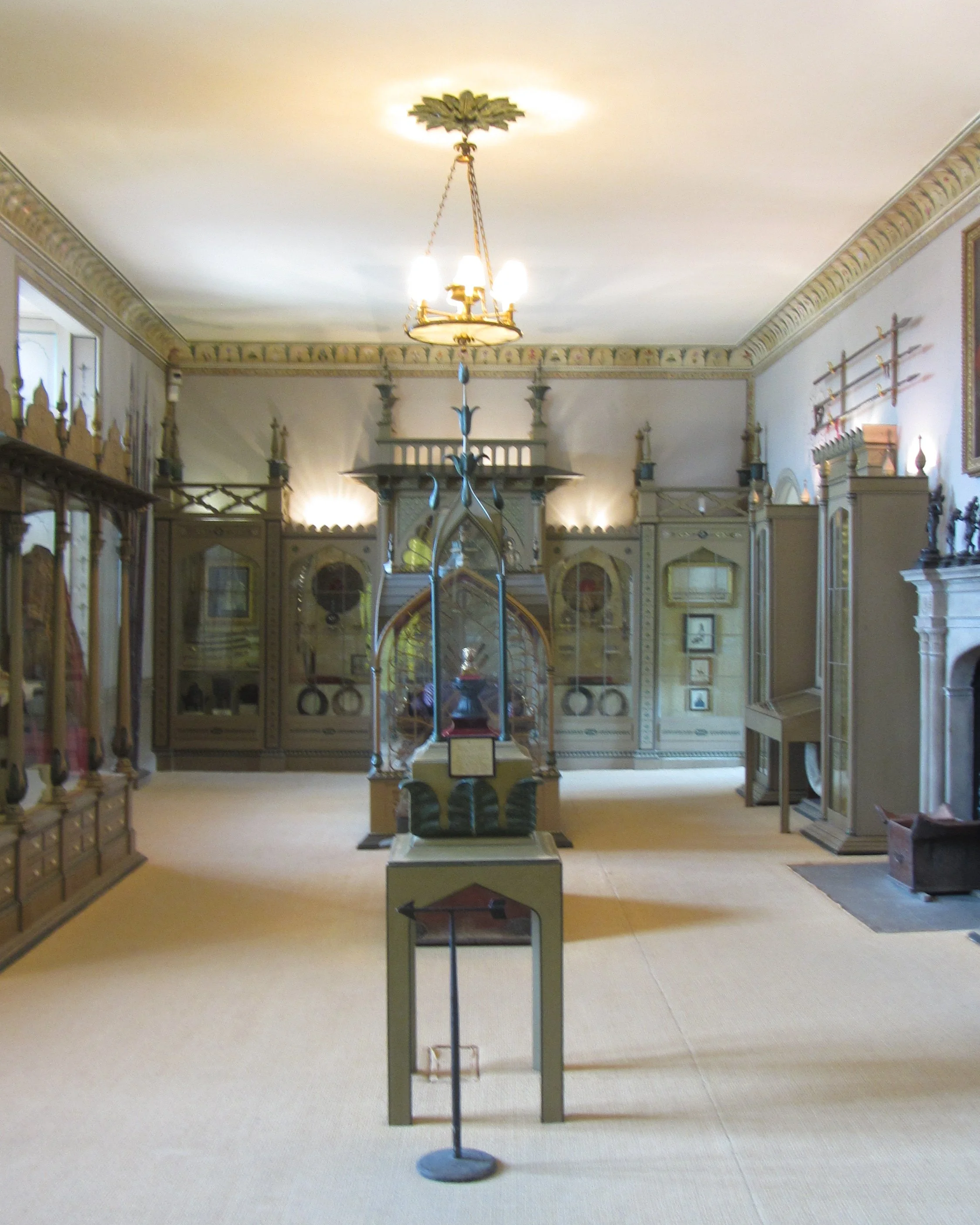
Alec Cobbe designed the display cases for the Clive Museum and wrote the labels by hand
Some of the Eastern curios had arrived courtesy of Cobbe’s Indian ancestress, “the Begum”, who married a Cobbe in India. In the 1980s, Cobbe resurrected the atmosphere of “ye Ark” for the Clive Museum at Powis Castle, designing ravishingly inventive cabinets in the “Hindoo” or “Indo-Gothic” style to house their exotic treasures from the Raj. He also created movable display cases (which he called “Gothic Lego”) for drawing and print exhibitions at Windsor Castle, and at Holyroodhouse he displayed the Stuart relics in ornate cases inspired by over-the-top Scottish funerary monuments.
At Newbridge, the marvels of the cabinet included giant deer antlers from the Pleistocene, a silken shoe from China containing a model of a bound foot, and “worse still, two real human hands, one mummified and the other… supposedly found in a bog, whose blackened skin was peeling away to reveal the bones”. These, and a book of anatomical drawings, resolved Cobbe to read medicine at Corpus Christi, Oxford, after his prep school at Brambletye in Sussex (where his Irish accent was teased out of him) and St Columba’s College near Dublin.
As an undergraduate he won a prize for his anatomical drawing of a kangaroo’s innards and was commissioned to paint a 30ft mural to mark the college’s 450th anniversary. He also bought an 18th-century fortepiano for £70, as he could not afford a modern piano, by the firm that had made Haydn’s instrument.
This was the first step down a slippery slope that would find him custodian of an astonishing collection that amounted to a history of the sound of the keyboard, including instruments owned or played by Purcell, Haydn, J C Bach, Mozart, Beethoven, Chopin, Bizet, Elgar, Mahler, Debussy and Vaughan Williams, as well as Napoleon’s 1810 square piano and Marie Antoinette’s 1787 pianoforte.
Disenchanted with the grind of post-mortems, Cobbe abandoned his medical studies at the London Hospital in Whitechapel to pursue a career as a painter of trompe l’oeils, an engraver of glass and a restorer of pictures, where his X-ray training served him well. It was his frustration at seeing paintings he had painstakingly restored being slapped against unsympathetic backgrounds that led him to advise on hanging.
He continued to sift through the unsorted treasures of Newbridge, and when Stanley Kubrick arrived to shoot a redcoat scene for Barry Lyndon – a location eventually abandoned for fear of the IRA – a line he showed Kubrick from an 18th-century Cobbe letter found its way into the film: “John has gone to Oxford to learn how to preach and pray.”
When Cobbe found proof that Newbridge was the work of James Gibbs, making it the earliest Irish Georgian house to be designed by a leading architect from the British mainland, it was the first of several coups of identification he enjoyed in his lifetime.
Another came in 2009, when the Shakespearean scholar Stanley Wells endorsed his thesis that a beruffed Tudor portrait in the Cobbe collection could well be the playwright, painted in his lifetime, around 1610. Many were convinced, encouraged by the Cobbes’ connection to Shakespeare’s literary patron, Henry Wriothesley, 3rd Earl of Southampton. Others were more sceptical, including Sir Roy Strong, who dismissed it as “fantasy” and “codswallop”. Nevertheless, the Cobbe portrait was adopted on posters all over Stratford-upon-Avon.
Cobbe also owned a portrait labelled as a Wriothesley descendant, Lady Norton, but which he came to believe was a strikingly androgynous portrait of the teenage Earl of Southampton, thought to be the “fair youth” of the sonnets. When Cobbe aired his thesis, he was delighted by The Sun’s headline: “That ain’t no lady”.
He made headlines as a restorer when he took the gamble of scraping the top layer off Tobias and the Angel, regarded as being by a follower of Titian, to reveal a very different double portrait of a mother and daughter underneath, now thought by many experts to be an autograph, but unfinished, Titian. He also bought a Venus and Adonis, which X-rays revealed to be filled with changes of gesture – suggesting it was not a copy but an experimental workshop version, and that “Titian was still fiddling with it when he died,” said Cobbe.
He more than doubled the size of the picture collection he inherited, to over 700 works, which hang between Hatchlands and Newbridge. The latter was sold to Dublin County Council in 1985, principally for its parkland, but in an enlightened and unprecedented deal the council invited the Cobbes to maintain a foothold in the house if they kept their furnishing and paintings in situ. Newbridge remains the only publicly owned stately home in Ireland still inhabited and furnished by the family that built it.
Hatchlands Park, described by Repton as “a palace dropped accidentally in a sheep walk”, was a sad shell when Cobbe took on the lease from the National Trust in 1987, but he transformed its chilly interiors into what Simon Jenkins called “a jewel in the National Trust crown”. Cobbe’s greatest challenge was to secrete some 50 keyboard instruments across various room without making it look “the musical equivalent of a car showroom,” he said.
Regular concerts began in 1988 with Mitsuko Uchida. Cobbe declared that “a good-quality room does for music what a good-quality frame does for a painting.”
A compulsive worker, Cobbe began his day in the small hours, restoring paintings, often before driving hundreds of miles to work on a project. His sometime assistant Edward Bulmer, despite being much the younger man, recalled “clinging on to the coat-tails” of a man who seemed never to sit down, unless it was at a piano. Cobbe also found time to paint, with several London exhibitions.
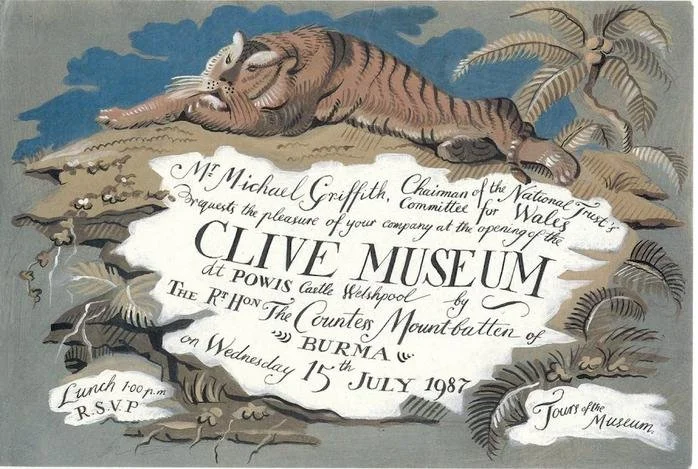
His discipline of aiming to have just an apple for breakfast each day was neatly balanced by his passionate love of ice-cream in the evening. He had an Irish flair for storytelling, with richly realised characters, the punchline often tantalisingly delayed by his own fits of laughter. He was a generous host, and his Rex Whistler-style invitations – both for his own parties and other people’s – embellished mantelpieces long after the event.
He was appointed CVO in February, when the King came to Hatchlands to visit him in his final illness.
Alec Cobbe once said that he had three ambitions in life: to marry Isabel Dillon (daughter of the 20th Viscount Dillon), who on their first meeting asked him to play the tune from the 1963 film Tom Jones; to have a large family; and to save Newbridge for the future. He achieved all three.
His wife Isabel, whom he married in 1970, survives him with their two sons and two daughters.
Alec Cobbe, born January 9 1945, died March 31 2026