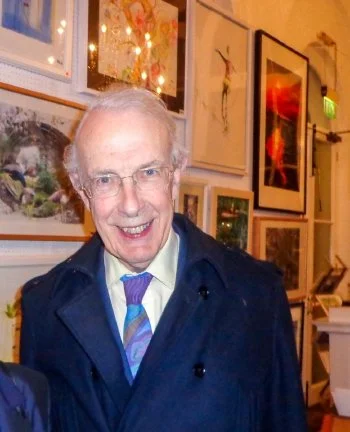
Sir Angus Stirling, Director-General 1983-1995, dies aged 92
Sir Angus steered the National Trust away from controversies, saying ‘We are not a political lobby’.
This obituary appeared in the Telegraph:
Sir Angus Stirling, who has died aged 92, commanded the heights of Britain’s cultural establishment as chairman of the Royal Opera House, director-general of the National Trust and deputy secretary-general of the Arts Council.
A connoisseur and amateur painter of patrician stock, once described as having “the informal urbanity of an old-style diplomatist”, Stirling spent part of his early career as a banker at Lazards before joining the Arts Council of Great Britain, as it then was, at the beginning of 1971.
According to the Council’s historian he was a “devoted and inspirational figure” who established relationships of trust with the Council’s clients and embodied the “Keynesian line” – the principle of serving artists rather than audiences, at arm’s length from government, as established by the Council’s postwar founder John Maynard Keynes. Its chairman, the publisher Lord Gibson, called Stirling “a tremendous liberal, who wanted to see the good in everything”.
Stirling was widely regarded as heir apparent to the secretary-general, Hugh Willett, but when the job came up in 1975 the fact that both he and Pat Gibson were Old Etonians – at a time when the arts world was eager to counter accusations of elitism – counted against him; and indeed Gibson himself was not convinced Stirling was ready for the top job. It went instead to Professor (later Sir) Roy Shaw, the product of a Sheffield grammar school education who believed ardently that the arts should be more accessible and that the Council should direct a portion of its funds towards adult education.
The abrasive Shaw and the genial Stirling were ill-matched, and the latter was effectively sent out to grass, with responsibility for the provinces. He saw it as his task to support artistic excellence wherever it resided and was instrumental in saving several historic theatres, as well as helping to establish Opera North in Leeds. But the regional arts associations through which the Council operated were increasingly dominated by local authorities whose judgment – particularly in relation to anything innovative – he found unsound, and sometimes deplorable.
By 1979 Stirling felt that the budget-squeezed Council had lost its way, and that his missionary efforts were bearing scant fruit. He accepted an invitation to become deputy director-general of the National Trust – where Gibson was now chairman, though he scrupulously left the recruitment of Stirling to his deputy chairman Mark Norman, who had been Stirling’s boss at Lazards.
There was more than one attempt to bring Stirling back to the Arts Council as Shaw’s successor, but he was soon deeply absorbed in his new job. The first property acquisition he negotiated for the Trust was Canons Ashby, an Elizabethan manor in Northamptonshire, but perhaps the most symbolic, in 1982, was that of the wild Kinder Scout estate in the Peak District – the scene of a historic mass trespass, 50 years earlier, in support of public access to open countryside.
Within days of his promotion to director-general in 1983, he clinched the purchase of Belton, England’s finest Restoration house, against an American bidder. Other acquisitions included Fountains Abbey, Studley Royal, Calke Abbey and Kedleston.
On a broader front, he embarked on a redefinition of the Trust’s role in a rapidly changing world. Though it owned 500,000 acres and 350 historic houses, he avowed that it should not “adhere to the ideas of the landed aristocracy”; even less should it “regard itself as a national heirloom”.
He was determined that it should engage with a wider public, and (somewhat in contrast to his stance at the Arts Council) felt the way to do so was to place more emphasis on education. He defended the idea that donor families should continue to inhabit their houses on the grounds that “the public not only appreciate it but benefit from it.”
According to one observer, “he was committed to the principle that the purpose of preservation was to give sustenance to people, that the Trust needed to recover the quality of humanity which infused the idealism of the founders, without losing its primary allegiance to conservation.” One manifestation of this new sense of social purpose was the refurbishment of Sutton House, a Tudor courtier’s house in Hackney, as a venue for lectures, seminars and music.
Stirling was a very safe pair of hands for the Trust, doing his best to steer it away from controversy over hunting on Trust land and other environmental issues (“We are not a political lobby”). He presided over a tripling of membership during his 12-year tenure, and the Trust’s centenary celebrations in his retirement year, 1995.
“Tall, highly articulate, both in speech and on paper, he was sensitive to people and, despite a certain reticence, attracted great loyalty from his staff,” recalled Dame Jennifer Jenkins, who chaired the Trust between 1986 and 1990. “A persistent taste for adventure was masked by his conventional dress, and once landed him down a crack in an Arctic ice-gap.”
From 1991, Stirling also shouldered the less happy burden of the chairmanship of the Royal Opera House, where he had been a board member since leaving the Arts Council and which faced very significant challenges, both in the decrepit state of its 19th-century backstage facilities and in the results of failures to break even year on year, despite large public subsidies.
It was hoped that Stirling – “one of nature’s ambassadors,” as James Lees-Milne described him – might have more luck in coaxing an increase in public funding than the more assertive previous chairman, John Sainsbury (later Lord Sainsbury of Preston Candover).
Stirling inherited an accumulated deficit of £2.5 million, which rose by another million in the following year, partly due to an orchestra strike. Though stability was briefly restored – assisted by a sharp hike in ticket prices which was itself controversial – the deficit had risen again by the end of his term in 1996.
Accusations were aimed at his board, and his chief executive Sir Jeremy Isaacs, of a “shambles”, both in financial management and in the planning of the £150 million redevelopment of the theatre, for which the National Lottery would provide a large slice of the funding.
The nomadic existence of the opera and ballet companies during an extended closure for building works came under particularly fierce scrutiny, satisfactory temporary premises not having been secured. Stirling told a House of Commons committee that such criticisms were “silly and shallow”, but the committee’s report found “incompetence” in the board’s handling of the closure, and a “sorry train of events” overall.
Art was Stirling’s consuming passion. He collected modern Scottish art, and was an enthusiast for model soldiers. There had been several amateur artists in his family, and he devoted his own retirement years to painting in a strong and attractive semi-abstract style; one critic compared his handling of light and colour in landscapes and views of Venice to the technique of JWM Turner.
Angus Duncan Æneas Stirling was born on December 10 1933. He was descended from the Rev John Stirling of Craigie, who was Moderator of the Church of Scotland in 1833 and whose son, also John, made a Victorian fortune as an ironmaster and acquired extensive estates in Ross-shire.
Angus’s father Duncan was a grandson of the second John; known as “Golly” in the City, he became chairman of the Westminster Bank and briefly, after a 1969 merger with National Provincial, the first chairman of NatWest. Angus’s mother, Lady Marjorie, was a daughter of the 8th Earl of Dunmore, who was awarded a VC during the Malakand Rising on the North-West Frontier in 1897.
Angus was educated at Eton and Trinity College, Cambridge, where he read architecture and history, later taking a diploma in the history of art at London University. He began his working life as a junior in Christie’s picture department but in 1957 he followed his father into the City and joined Lazard Bros, where he worked on mergers and acquisitions.
In 1966 he left to help establish the Paul Mellon Foundation for British Art, of which he was assistant (and later joint) director. The foundation’s first assignment was to assemble a collection of important British paintings destined for Yale in the United States; when the task was done, Stirling found himself out of work on Christmas Eve 1970. But the Arts Council chairman Lord (Arnold) Goodman had already talent-spotted him.
During his Covent Garden years, Stirling was a governor and deputy chairman of the Royal Ballet. At various times he was a council member, governor or trustee of the Byam Shaw School of Art, the Courtauld Institute, the London Symphony Orchestra, Live Music Now, the Theatres Trust, the Royal School of Church Music, Gresham School and Stowe House Preservation Trust. He was also president of the Friends of Holland Park and a former Prime Warden of the Fishmongers Company. He was knighted in 1994.
He married in 1959 (Armyne) Morar Schofield, a granddaughter of the 21st Lord Hastings; they had a son and two daughters.
Sir Angus Stirling, born December 10 1933, died June 1 2026Th