

The latest on the Clandon Park planning application

The National Trust’s vision for the Library at Clandon Park
We have not been granted permission to proceed with our judicial review against the Secretary of State, but the Georgian Group has succeeded in getting permission to proceed against the Guildford Borough Council. Country Life reports,
Landmark case brought for ‘heritage protection’
18 Feb 2026
Julie Harding
Leaving fire-damaged Clandon Park in Surrey unrestored could weaken protections for other listed buildings, with restoration no longer guaranteed after similar disasters
NATIONAL TRUST redevelopment proposals for the Grade I-listed Palladian house Clandon Park in Surrey, which was left a charred shell by a ferocious fire in April 2015, will form the subject of a judicial review after permission was granted by the High Court last week. It comes after the Georgian Group launched proceedings against Guildford Borough Council, which gave planning and listed-building consents on November 11, 2025, to the Trust’s controversial proposals. The group is calling these consents ‘unlawful’ and is saying that they set ‘a dangerous precedent’ because they fundamentally undermine heritage protection for fire-damaged listed buildings.
The judicial review concerns an extremely important general principle
‘We continue to believe that if the Clandon consents—predicated on the notion of a “postfire significance”—are not quashed, this will set a dangerous precedent with far-reaching negative consequences for designated heritage assets,’ says the Georgian Group’s director, Dr Anya Lucas. ‘The judicial review… concerns an extremely important general principle, as well as an important listed building.’
The judicial review was granted on eight grounds, including that Guildford Borough Council adopted a ‘post-fire baseline’ for assessing significance (in other words, it was mistaken when determining that the assets and the scheme must be assessed against Clandon’s current state or when assessing the building’s significance), took a flawed and inconsistent approach to heritage benefits and impacts and that it failed to consider alternative schemes or the cumulative harm caused by the proposals. ‘We will defend our decision at a hearing,’ a council spokesperson told COUNTRY LIFE, as another for the Trust stated: ‘The National Trust remains committed to completing its proposed scheme, which will conserve the surviving building at Clandon and renew it as a welcoming, fully functional building for current and future generations.’
The plans for Clandon put forward by the Trust (the Trust itself isn’t a defendant in this case, but is an interested party) were drawn up by Allies and Morrison for the once exceptional house that was the most complete surviving work by architect Giacomo Leoni (about 1686–1746). Once approved by the council, they were referred to the Secretary of State, Steve Reed, who could have called for the application to be judged at an inquiry. He didn’t, so campaigning body Restore Trust applied for its own judicial review over his decision, but this was recently refused, with Cornelia Van der Poll telling COUNTRY LIFE: ‘An application as important and controversial as this should have been called in by the Secretary to be decided at a planning inquiry... Instead, the decision of a single hurried planning-committee meeting is allowed to stand, even though the committee members admitted to not having mastered the complex details of the application… We will continue fighting for Clandon.’
The National Trust’s plans would keep the interior largely in its fire-damaged state, which would, project director Kent Rawlinson said in 2022, enable visitors to see the ‘raw power and poetic beauty’ of the ravaged remains, facilitated by a series of walkways and stairs. The exterior, according to the Trust, which took ownership of the park in 1956, is undergoing conservation work and will look as it did pre-fire, although detractors claim that the new roof is unsympathetic and modern and a lift shaft towers over the old chimneys.
With the Georgian Group’s case designated as a Significant Planning Court Claim, it will be expedited through the system and could be heard as early as May by a specialist judge.
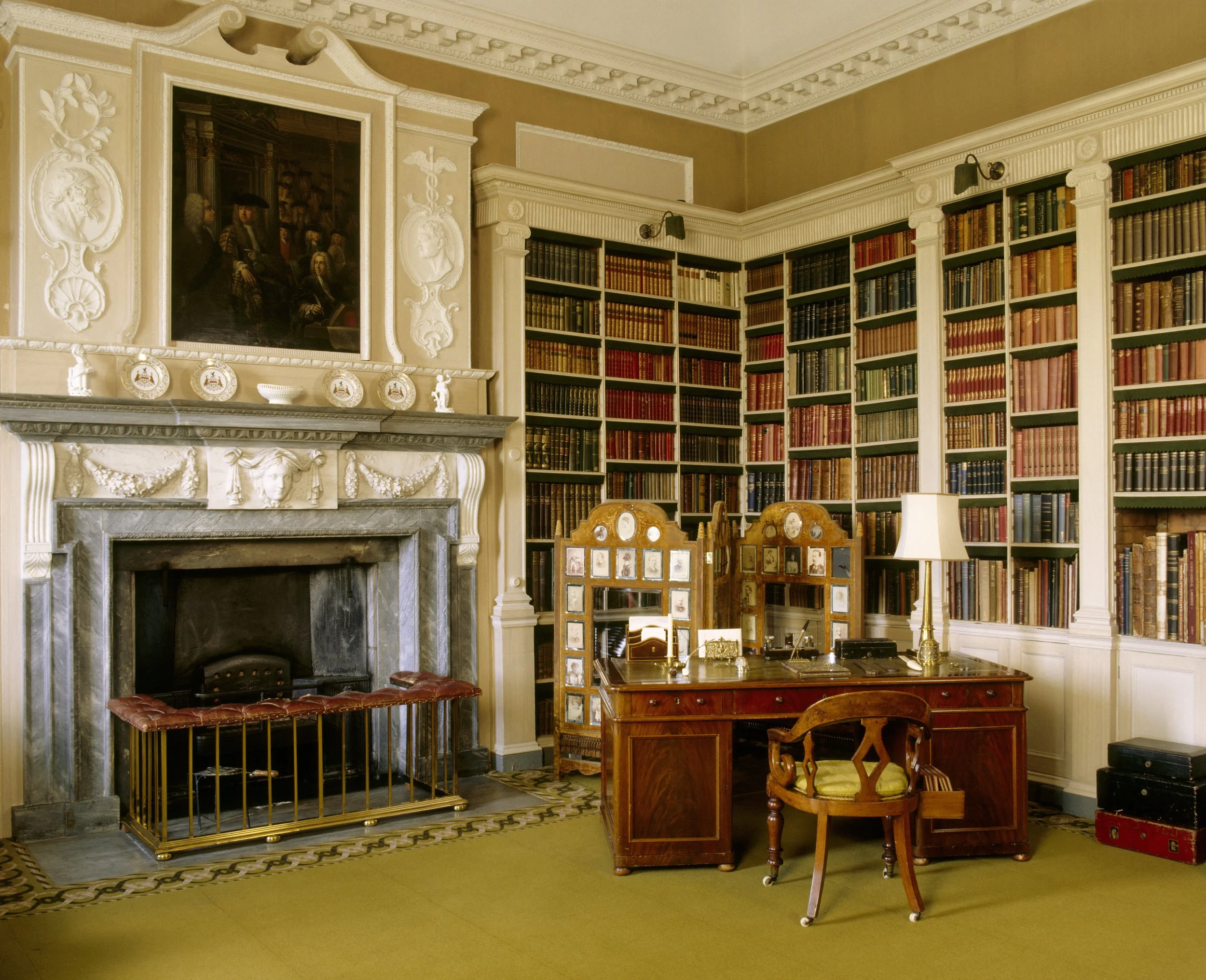
The Library before the fire