

Selective outrage at Kedleston Hall
A young black visitor is dismayed at the virtue-signalling on display and longs for some old-fashioned factual presentation
The most recent exhibition offers more emotion than fact
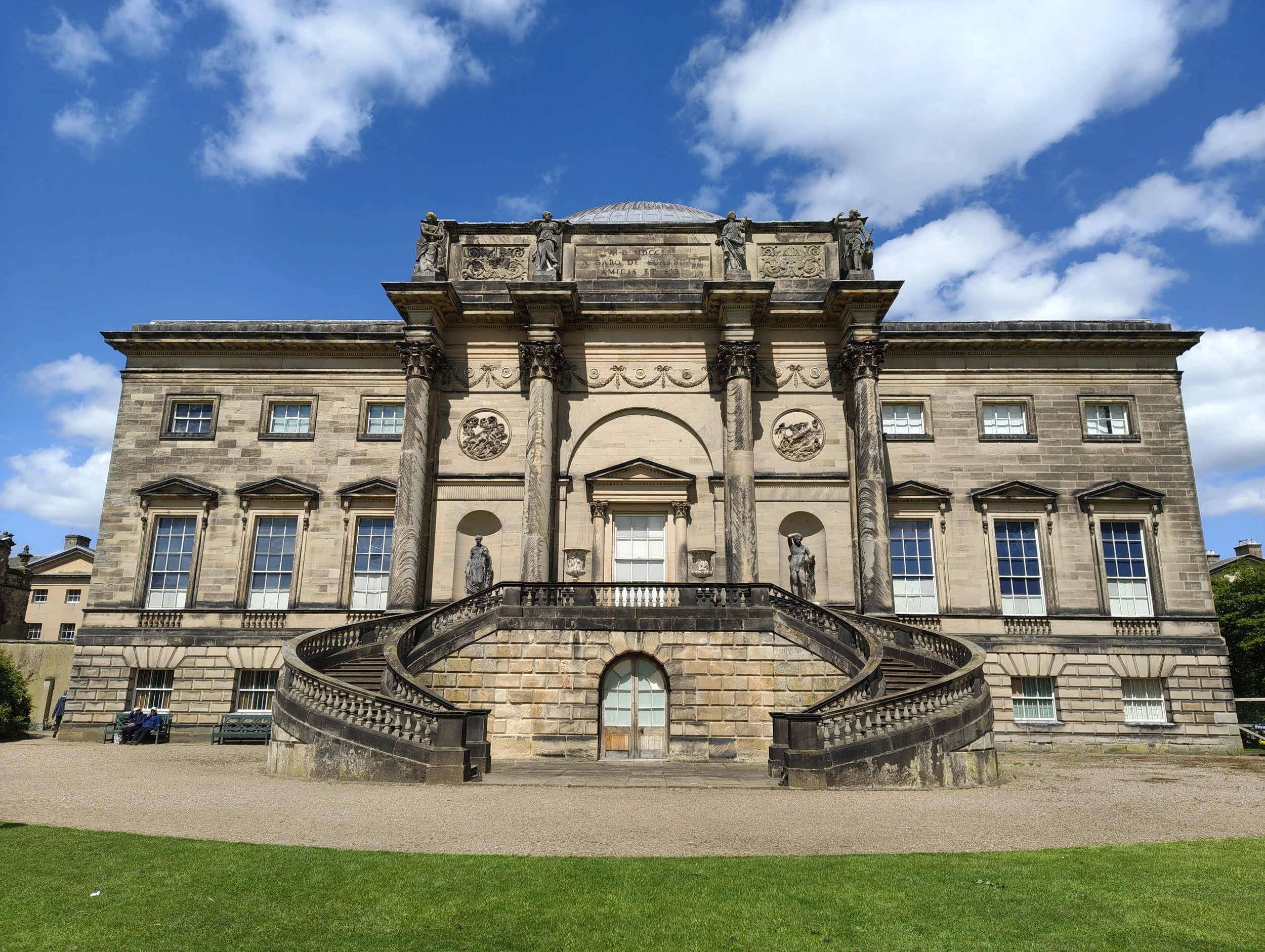
Kedleston Hall is the ultimate show-off house. Since it was built in the 1760s, the purpose of this house has been to impress. And I was impressed when I visited in late 2025. The house is astonishing. Every room is a window into local and international cultures. The house tells us about the Curzons' wealth and influence, both locally and abroad and displays their taste and interest in art, design and culture.
Kedleston Hall was built in the neoclassical style in the eighteenth century
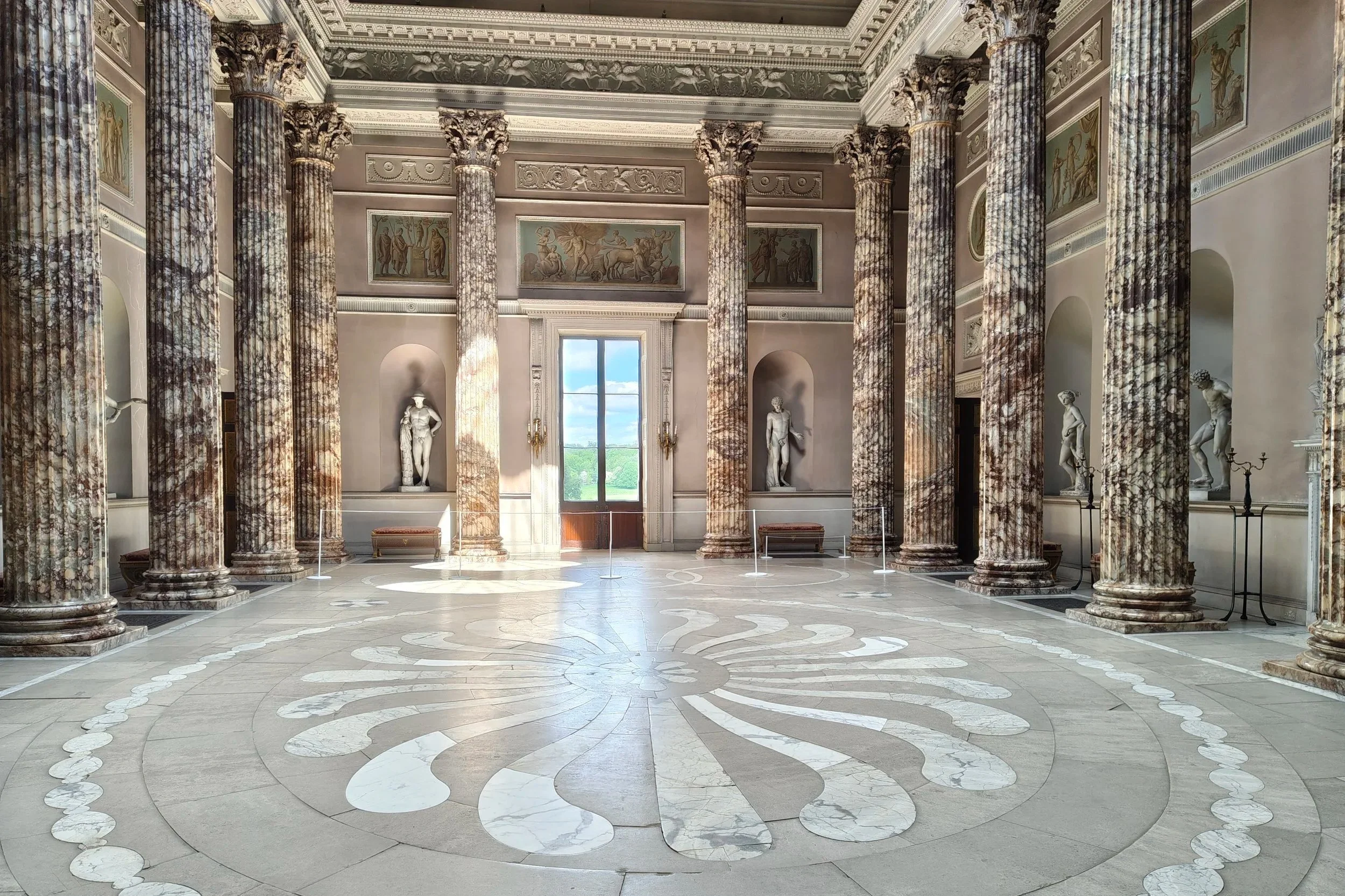
The house was built in the neoclassical style and evokes ancient Rome. Nikolaus Pevsner describes the Marble Hall as ‘one of the most magnificent apartments of the 18th century’. It has the grandeur of a Roman temple, with huge columns, statues in niches, a marble inlaid floor and a profusely decorated ceiling. The room is lit from above by skylights to resemble the atrium of a Roman villa.
The Marble Hall evokes ancient Rome
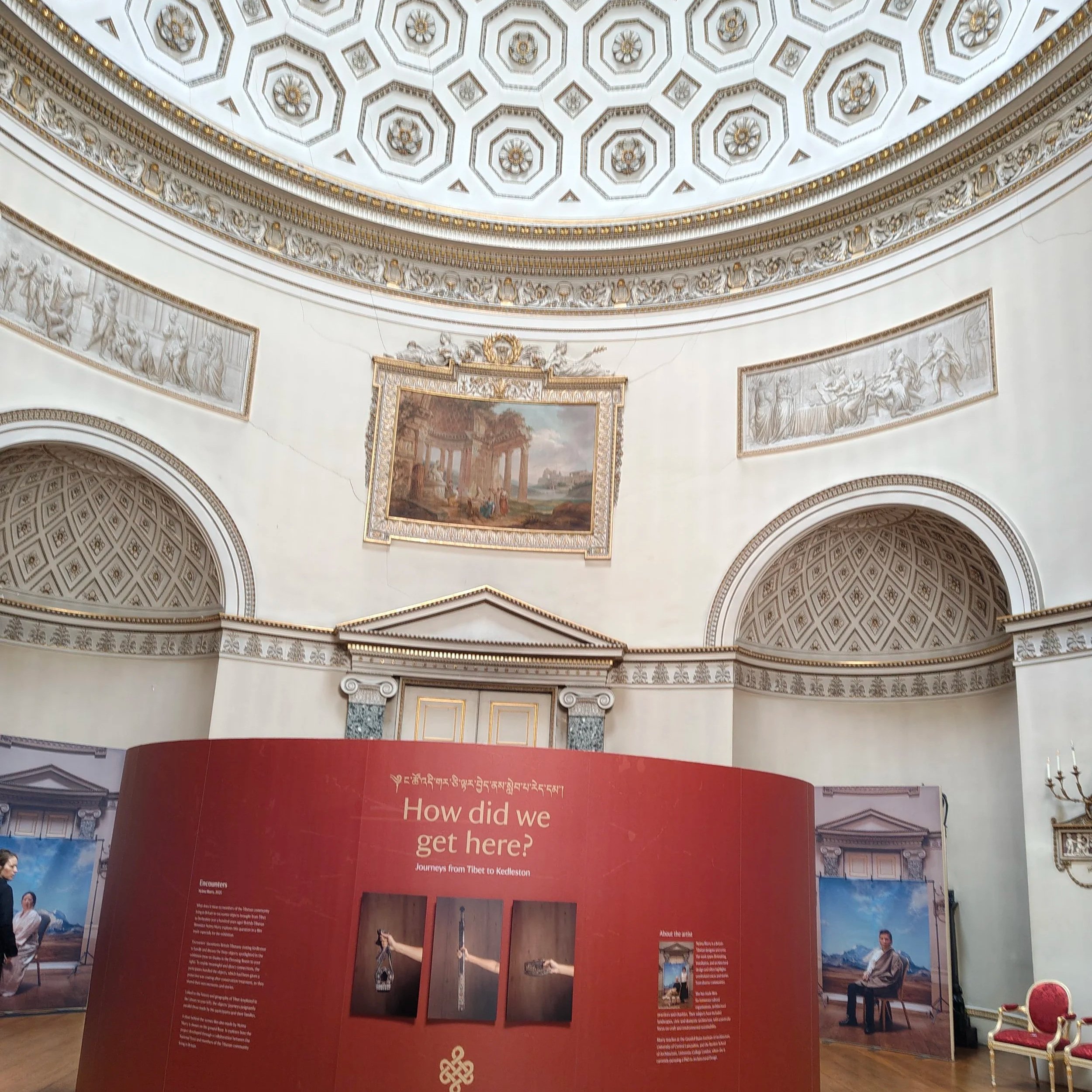
The Saloon is another grand room in the Roman style with massive proportions, inspired by the Pantheon in Rome with a domed ceiling and a skylight in the centre.
The domed Saloon is reminiscent of the Pantheon in Rome
The Drawing Room is an absolute masterpiece. The walls are covered in a light blue silk damask which matches the upholstery on the richly carved and gilded sofas. The ceiling and furniture are decorated with mermaids and sea-monsters which convey the maritime theme of the room.
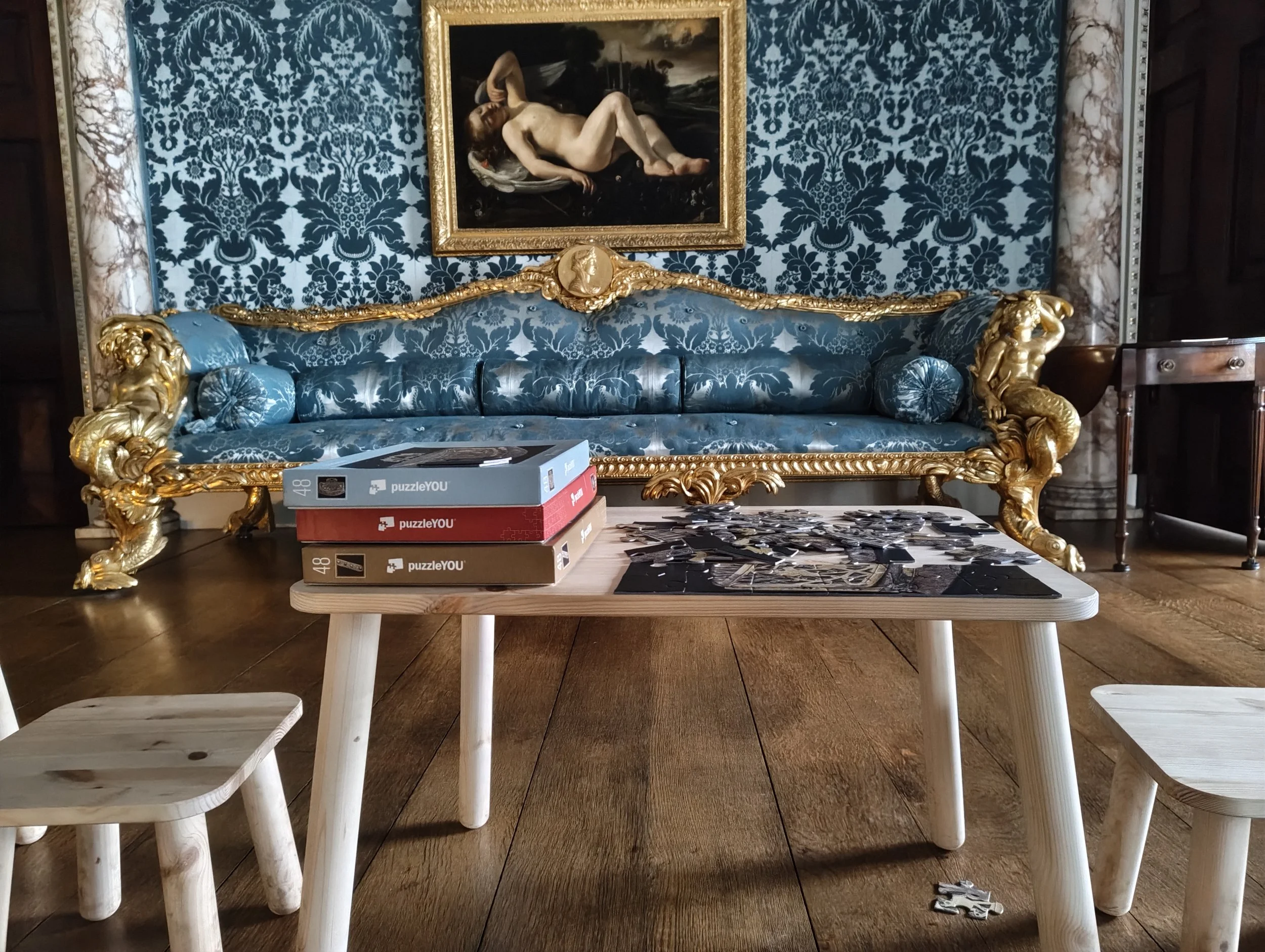
The Drawing Room contains superb carved and gilded sofas in the Rococo style by John Linnell
This house was built and designed to impress and inspire. The rooms are decorated not only to look grand and beautiful, but also to convey stories and ideas.
The ground floor rooms are dedicated to the Eastern Museum, a collection of artefacts which George Curzon brought back from his travels in the Indian Subcontinent and the Far East.
There are speech bubbles on display at Kedleston which express the views of visitors, some intrigued and mesmerised by the learning experience and art, and others who are disgruntled by the presumed possibility that George Nathaniel Curzon had ‘stolen’ or obtained ‘immorally’ much of his Asian art collection. Such concerns are inevitable given the complex history of colonialism. In a notice in Curzon’s gallery of Asian art, we are told
‘There are many things we do not know about this collection, numerous questions to be answered and stories to unravel. How and where Curzon acquired the objects is one important question…Over the coming months, different partners will help us re-represent objects selected from the museum’.
Despite the show of listening to different points of view, the message of the new display is a foregone conclusion. The National Trust pretends to hear dissenting voices and pretends that their views may yet make their way into the exhibition. The fact is that it is being designed to be judgmental and magnify all Curzon’s actions which show him in a bad light while minimising or ignoring the good he did.
George Curzon served as Under-Secretary for India. He was extremely interested in foreign affairs and wrote extensively about Asia and Russia. Given the importance of the British Empire at the time, this interest is unsurprising. In 1899, he was appointed as Viceroy of British India for the period 1899 to 1905, making him the monarch’s representative. During his time as Viceroy, he made contentious decisions such as dividing the region of Bengal into two parts; he also made decisions that many might appreciate today such as helping to repair and protect the Taj Mahal, because it had fallen into poor condition, and he redesigned and restored the gardens around the Taj Mahal to make them closer to their original Mughal design. So yes, he was clearly an imperialist. He obviously held views and values that we probably would not align with, however, he clearly also held views and values that we would align with. According to the logic of the National Trust, because of the former, we must reinterpret history to inform the public of how much we condemn his flaws. Because of this, George Curzon’s Asian collection of art on the ground floor has attracted and continues to attract contentious debate concerning its perceived ‘oppressive roots’ and ‘cultural appropriation’. He acquired things for a variety of reasons. Some were given to him, but he also bought and commissioned others. This nuance is completely ignored because it goes against the popular narrative and movement that activists adhere to religiously.
The Asian art is truly beautiful and many really do appreciate the fact that they are able to travel back in time with these objects and imagine the role they once played or what they once meant.
Interestingly, when faced with the culture of ancient Rome, curators do not point out that the society of that empire was founded on slavery and conquest. When the culture that is being showcased is non-European, for instance, Asian or African, on the other hand, colonialism and slavery get the headlines. Unfortunately, Kedleston has been the target of attacks of this kind; particularly due to Lord Curzon’s interest in Asian art, which appears inexplicable to those who are not familiar with his cultural pursuits. A casual observer may think that Curzon acquired them through theft and looting and that his interest in them was limited to greed, and the presentation of the Eastern Museum does nothing to correct such an impression.
The political activism which seeks to make violent oppression the central theme of the house as it is shown to visitors today makes little sense. And if imperialism is such a pressing issue, why not spare a thought for Ancient Rome as represented in the Marble Hall and Saloon?
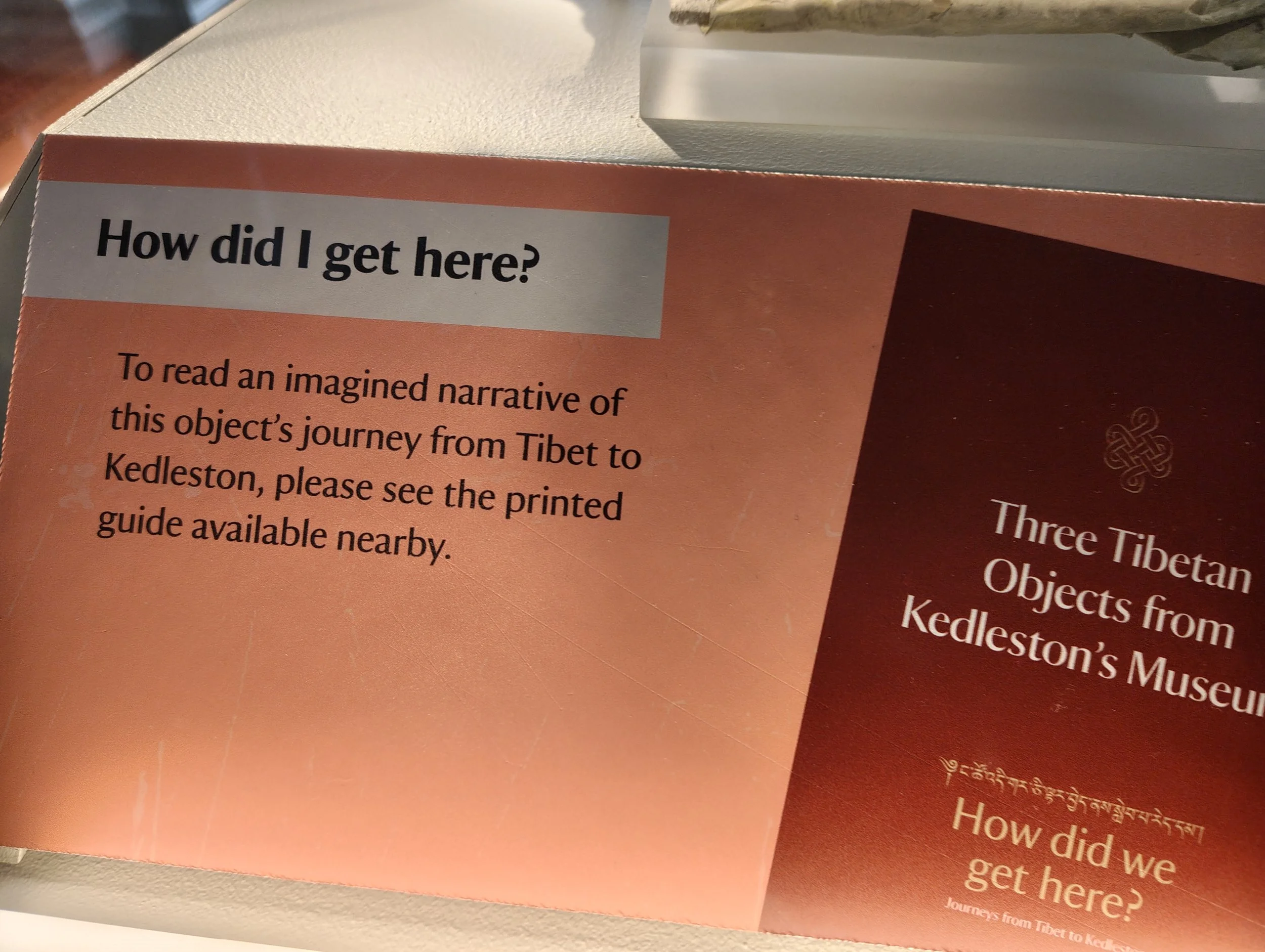
A new exhibition at Kedleston demonstrates how focus has shifted from what the artefacts are and the context in which they existed or functioned to why they are now at Kedleston. Questions are displayed in the exhibition such as ‘How might it feel for a British-Tibetan to encounter them here?’. These are strategically placed to trigger emotions such as loss and anger in the audience. The accusing questions are prominent and numerous. Explanations of what actually happened are much less prominent and their content is vague and speculative, hinting at nefarious behaviour on Curzon’s part without presenting firm evidence. Such an approach has nothing to do with preserving and conserving the art and is not part of the purpose of the National Trust.
Conservation isn’t just about preventing physical damage. It also involves conserving the knowledge surrounding the artefacts. The artefacts have a cultural context, namely Tibet and British India at the turn of the twentieth century, but the display uses this context to suggest disingenuously that they have been stolen and that their presence at Kedleston Hall is morally tainted. This is a deliberately one-sided presentation which looks less like curatorship and more like virtue-signalling. When factual history is replaced with post-modernist notions of ‘conservation’, when the artefacts themselves become a springboard for conversations about good versus bad and oppressors versus victims, then the real purpose of conservation is lost. When the objects become pawns in a blame game, their significance is eroded. They are no longer the first-hand evidence for history, but an ongoing accusation: ‘They shouldn’t be here.’ ‘They signify oppression.’ ‘Justice demands that they go somewhere else.’ This is not conservation. It is activist guilt-tripping.
The National Trust tells us that the collection is going to be re-presented. What does this mean? Does it mean presenting the art through a radical post-modernist lens? Does it mean condemning Curzon simply for the possibility that he obtained the pieces in ways that modern society would deem to be unfair or corrupt, and then attaching a judgmental label to the art which reads like an apology? If the acquisition of these objects is discussed out of context and framed as misdeeds to be disapproved of by today’s viewers, then Kedleston becomes no more than a politicised sneer at Curzon and British India. The house and collection could have offered an opportunity for people to step outside the norms and assumptions of their own time and come face to face with a very different society and culture. Gaining some understanding of a different time does not entail wholesale approval. Leaping to judgement, on the other hand, reduces the possibility of insight.
The harsh truth about history is that there are always things that we will dislike. Most of us are aware of history’s many flaws, yet our institutions often feel the need to guilt-trip society into constantly apologising for the moral failings of the past. The honest way to present heritage is to tell objective truth, without agenda or spin. We can debate, critique and ridicule as much as we like, but it doesn’t change the facts. When we make heritage political, we turn it into something we apologise for and continually regret, rather than learn from, appreciate and conserve. The National Trust has rescued many estates which would otherwise have been broken up and lost. The least we can do is appreciate what we have, and learn about the past and from the past. Let us stop apologising for and disapproving of our heritage. Conservation is better served by telling the objective truth.
I fear that a ‘reinterpretation’ will involve a selective account of the facts presented with emotion, and subjectivity. History consists of facts and cannot be interpreted anew to suit the mood of the time. The National Trust is seeking to reinterpret history, not due to the discovery of new historical facts or compelling evidence that something previously thought to be the case is not so, but due to the emerging tyrannical voices of modern-day politics who are offended and threatened by the history and want to change it to protect themselves from having to face the truth. In other words, the National Trust’s new strategy has been founded on and led with emotion and political pressure. When truth, objective fact and evidence are absent, we are left with half-truths, protest and politics.
What the revisionists don’t seem to realise is that the past is not pretty. Life was nastier for our ancestors than it is for us. This is easily overlooked, because it is so much easier to assume that conventions and ideas about right and wrong were always the ones familiar to us. As time progresses our moral compasses tend to also progress. Mankind isn't perfect, and our ancestors we certainly far from perfect. We are also nowhere near perfect. In ten or twenty years, you will look back at something ignorant that you said or did. And guess what? That’s perfectly okay. Some of the world’s most admired civil rights activists, like Martin Luther King, and war heroes, such as Winston Churchill had deplorable characteristics that we would probably condemn today. None of that cancels out the good things they achieved. Expecting the values of the past to conform to our own is an illogical approach to take, and yet the National Trust is falling into this trap, apparently from a shallow understanding of history and ethics.
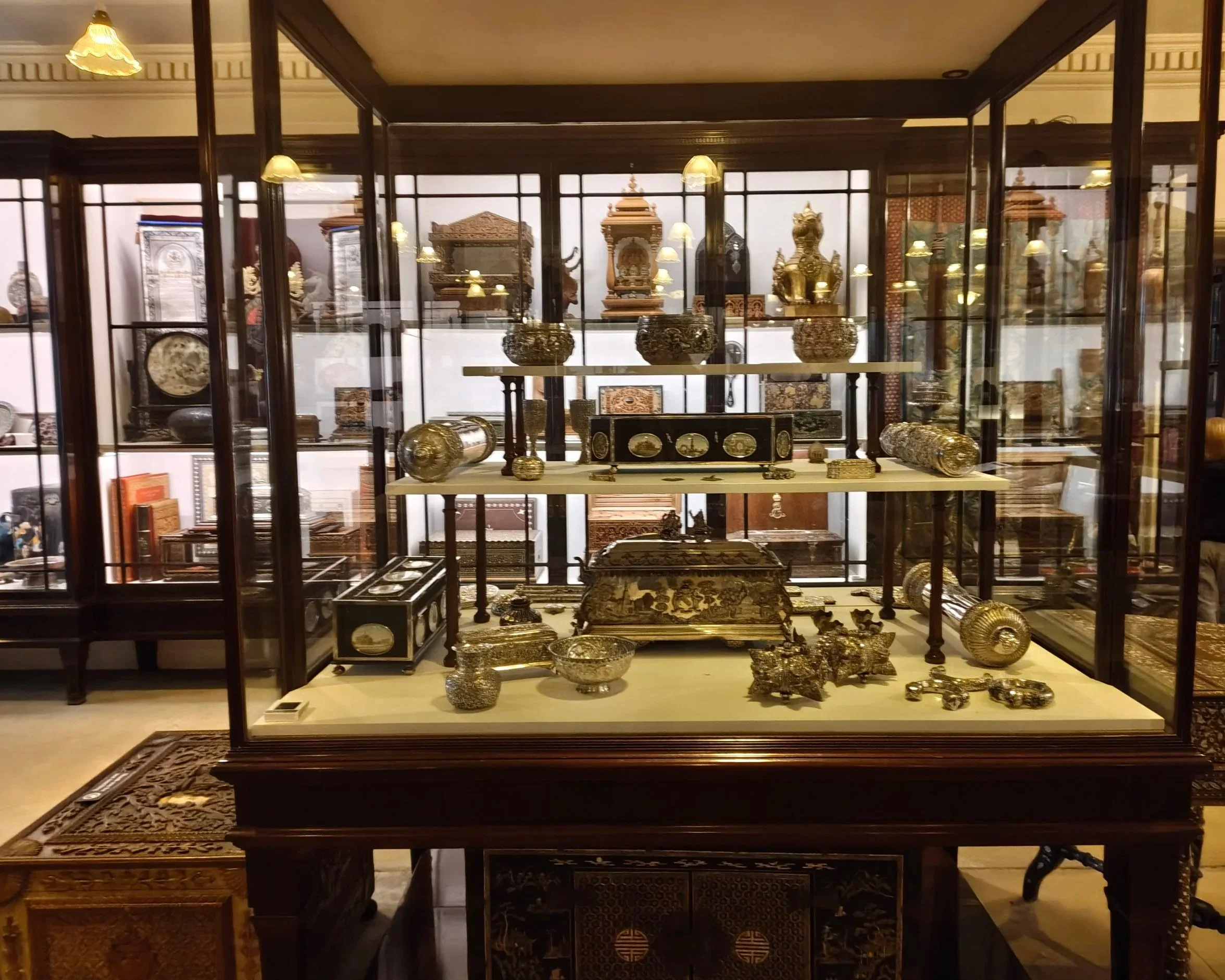
The Eastern Museum at Kedleston Hall contains Lord Curzon’s superb collection of art and crafts from the Far East and the Indian Subcontinent
As part of the ‘Colonial Countryside Project’, the National Trust aims to ‘reinterpret’ the colonial history of these houses. But what is meant by ‘reinterpret’? The dictionary definition is ‘interpret in a new or different light’. In what light is the National Trust ‘reinterpreting’ the history of these houses? All the evidence suggests that the history is being reinterpreted under the guise of post-modernist identity politics with the aim of decolonising National Trust properties. However, what they don’t understand is that a history of colonialism cannot be decolonised. It cannot be changed or reimagined. What happened is what happened and if all we have left are beautiful collections of art and artefacts, then why can’t we appreciate them without feeling guilty about the acts of previous generations that we know were probably wrong and that we cannot change. ‘Decolonising’ historical artefacts and events is not a natural part of conservation or the interpretation of history. It is a political act, and politics is not part of the role of the National Trust. Condemning things that everyone already disapproves of is a trivial gesture and not worthy of a serious conservation charity. The National Trust’s 5 million members rely on it to preserve, conserve and protect heritage and art, not to take a political stand.
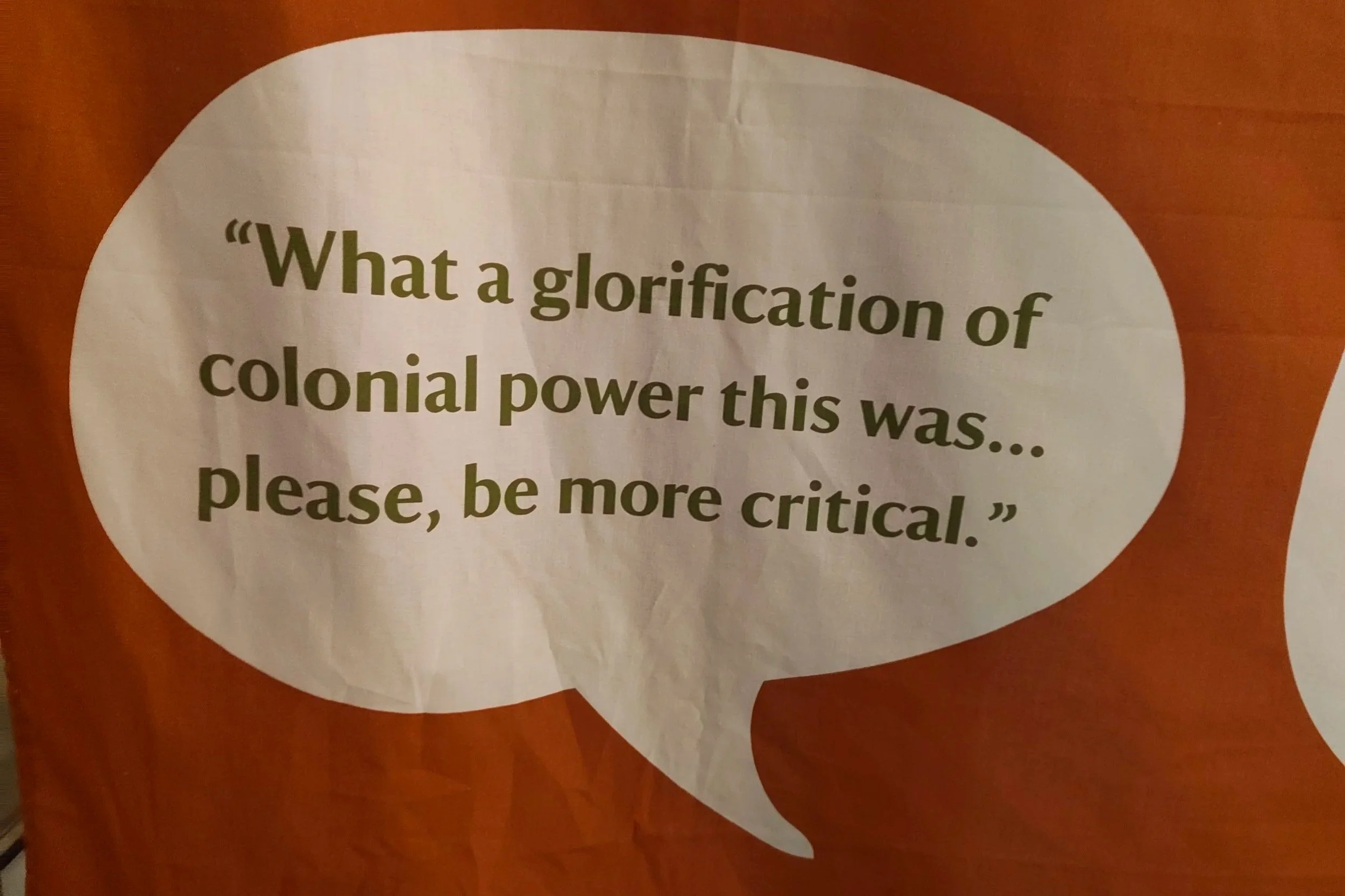
Visitor comments are on display in the Eastern Museum
In the context of politically partisan displays, it is interesting to note that Hillary McGrady recently spoke to Times Radio about the apparent involvement of the National Trust in the so-called ‘culture wars’. She said,
‘Do I regret getting embroiled in culture wars? Yes, I never wanted to be part of the culture wars. I didn’t set out to try to provoke or annoy people about this. Do I regret wanting to be an organisation that is genuinely for everyone, so that people, anyone who can come to our property can see themselves at our place? Can feel as if we’re telling their history as well as someone else’s history, that they feel as though they’re being heard? No, I don’t regret that at all.’
To me this response does not make sense. Firstly, the idea that the National Trust cannot be an organisation that is genuinely for everyone unless it bends over backwards looking for ways to include everyone is ridiculous. This is especially the case when such examples from history are presented partially and subjectively, often because in that the Trust may not have enough information to present the history objectively in its full context, yet still forces such history into its presentation of properties in the name of ‘inclusion’. This is an intellectually dishonest approach to take. This view that people of colour only feel included when they are referred to everywhere is kind of offensive. We are not vain and we are very much tired of being virtue-signalled towards. As a black person, I am not going to go to a Viking museum and protest because there was no information about ‘black Vikings’.
People of colour do not and should not rely on other races to have their voices heard or to feel heard. We are all self-sufficient human beings, irrespective of our racial differences. This way of thinking is, in my opinion, racist. Focus on the facts, evidence and research that you have at hand. Stop viewing people of colour as helpless victims who rely upon your virtue-signalling for acceptance and validation. When the Trust draws on generalisations about black people in its exhibitions or notices does not make me feel any better. I certainly don’t learn anything new. It simply reinforces generalisations and stereotypes. This is because since the links to slavery or colonial history are so forced, or otherwise presented out of context, that they can only be generalisations. It is particularly galling when the information offered on particular works of art not only conveys this race agenda, but is patchy or selective as well. That is how nuance is lost. All I ask is factual and complete information presented without an agenda. I am quite happy to accept it if some things are not known. What I cannot accept is the partial presentation of information for reasons that have nothing to do with good curatorship.