

A visit to Sudbury Hall
A visitor to Sudbury Hall is disappointed by the profusion of children’s toys in this important Restoration house, and also by the subjective approach to slavery
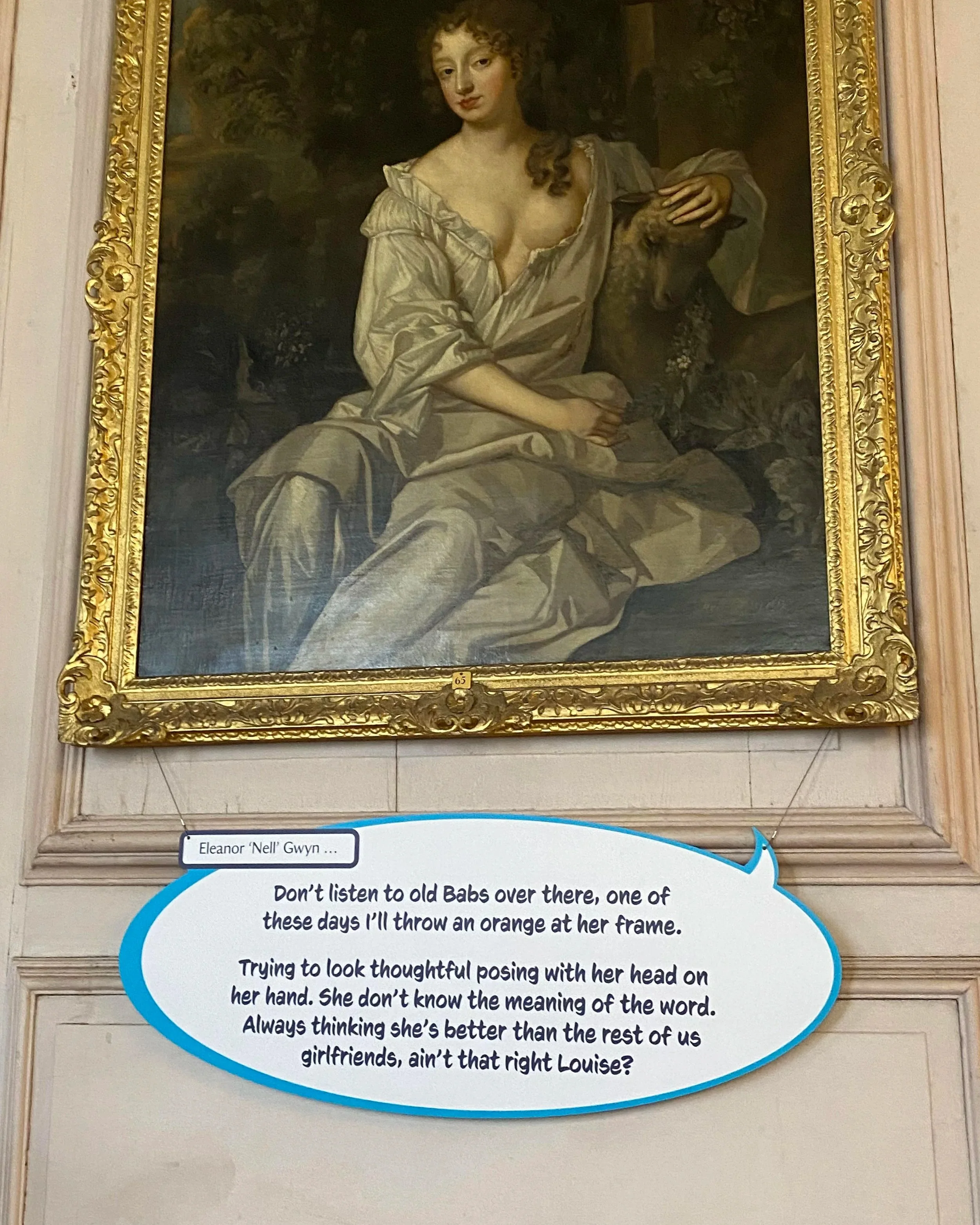
An erotic portrait of Nell Gwyn, mistress of Charles II, receives a child-friendly makeover at Sudbury Hall
Sudbury Hall: From Restoration Mansion to Children’s Country House
From one of Britain’s finest Restoration period country houses and iconic film location of Pride and Prejudice, to a children’s playground and the home of Pinocchio at Christmas…how did we get here? Sudbury Hall is a Grade I listed house from the reign of Charles II with exceptionally fine interiors lavishly decorated with plasterwork, paintings and woodcarvings.
Arrival at Sudbury Hall
I was told that Sudbury Hall had become something comparable to a children’s nursery; I took the comment with a pinch of salt as I thought that it was just exaggeration. I thought that either the extent to which the house had been tailored towards children has been blown out of proportion, or if it really has become a children’s playground, perhaps there is some good reason behind such a change… well, I was wrong!
To explore this fascinating conundrum further, I decided to hop on the train on a cold, rainy winter’s day to Sudbury Hall. Upon arrival, I struggled to find the house; it turned out that that was because the front courtyard had been transformed for the Christmas festivities. There were multitudes of pop-up Christmas market stalls, selling food, fancy gifts and unique antiques; it really got me feeling the Christmas festivities. As I made my way through the mini Christmas market, I finally found the house and trod through the wet, muddy grass to the entrance. Unsurprisingly, the entrance was packed with parents, with their very young children and pushchairs. I must say, the National Trust has been successful in ensuring Sudbury Hall attracts the audience they seem to want — I felt out of place as a single person with no children. If you have a large family, Sudbury is truly the place to be!
Pinocchio in a Country House?
Just as I entered the house, I had a huge surprise…a notice that read: “Welcome to the Children’s Country House…Christmas is a time for stories and this year, we invite you to step inside the magical tale of Pinocchio”. I thought, what has Pinocchio got to do with Sudbury Hall?
“The story of the wooden puppet who dreamed of becoming a real boy. As you journey through the Hall, each room reveals a new chapter. Walk through Geppetto’s workshop and into the bustling streets of the town. Immerse yourself inside the Land of Toys and experience the puppet theatre. Follow Pinocchio’s adventures as he learns about courage, honesty and love”.
Yes, I suppose Christmas is a decent excuse for such a display; yes, families enjoy seeing Christmas decorations and celebrations, but I came for the seventeenth-century country house and I was still hoping to learn about the history of Sudbury. I thought that perhaps the Trust would connect Pinocchio to the significance of Sudbury. However, as I walked through the house, I realised that I was expecting too much. The notice spoke for itself: the house was not only decorated — quite beautifully I must admit — with tinsel and glamorous Christmas trees, but with characters, toys and notices all telling the story of Pinocchio. I came to Sudbury Hall with the same purpose I have when visiting other National Trust estates: to find out about the art and the family to whom the home once belonged. This proved to be nearly impossible. I had to look hard for information about the paintings and furniture. From the notices on display I learned only about the story of Pinocchio. Even in the absence of the Christmas displays, I suspect there may not have been a great deal to be learned about the family portraits, works of art and decoration. It was disappointing to take in so much wonderful art and decoration without any kind of guide. Are the people at the National Trust not enthusiastic about such a special house? It seemed as if the history of the house and its art came second to the amusement of little children. There is no apparent reason why this has to be so.
The Long Gallery: Speech Bubbles and Infantilisation
I will start with the weirdest part of my Sudbury visit: my walk through the Long Gallery. As I entered the Gallery, I was mesmerised by the many wonderful portraits spread out along a grand and spacious corridor. It reminded me of the corridor that Anna from the movie Frozen sings and glides through, talking to the fabulous portraits of her ancestors. I looked for the labels to learn about the subjects of these portraits. To my surprise, I was met with a giant speech bubble. I looked around and realised that there were no labels of the kind I would expect under the portraits, but instead only these childish-looking large speech bubbles. Here are the ones which caught my eye.
Barbara Villiers and Erotic Suggestion
The first portrait was of Barbara Villiers who was renowned for not only her looks, but for being one of Charles II’s favourite mistresses. Many portraits were painted of her and she tended to be portrayed sensuously, with her bodily features exposed clearly signifying what she represented in society at the time. The National Trust’s speech bubble read:
‘It’s hard being the King’s favourite girlfriend but someone has to do it…see her with the plunging neckline three paintings down? Don’t let that lamb fool you…she’s using it to represent innocence but check out that look she’s giving me!’
There is no denying the erotic nature of the text in this bubble. Firstly, why are we focussing the attention of children on such sexual content? When I was a child I would have simply scanned past portraits of this nature, leaving the boring stuff to my parents to read. I certainly would not have taken any interest in the love lives of the subjects. Children could not care less. In fact, when I took these photos, it seemed as though the children were far too occupied with toys to pay attention to these silly captions that are seemingly aimed at making them laugh. Then the highlighting of a tension between the two women is also interesting as it is done in such an immature manner. The direction to look at the ‘plunging neckline’ is very peculiar and strikes me as somewhat inappropriate. Some things are better left unaddressed, especially when directed at under-age audiences. If all of the presumed tensions between the two ladies (assuming it is a historical fact; is it?) was explained in a factual way, that would be fair enough, but drawing the attention of children to what is really adult subject matter is a little dodgy. It occurred to me that the National Trust is having rather a lot of fun with the theme woman vs woman nastiness!
Henry Vernon and Trivialisation
Another portrait was of Henry Vernon, the son of William Vernon. The bubble reads: ‘They said this pose would highlight my importance and dignity but don’t you think I just look like I have indigestion?’. Honestly, I think that this is simply a desecration. If I were a descendant of this family, I would very much regret the handing over of our legacy to the National Trust if this is how they would reduce and trivialise my ancestors. And so it goes on with the rest of the speech bubbles under the portraits. They are, to be blunt, weird and inappropriate. While some may think this is harmless humour, I take the same view as Joanna FitzAlan Howard, the daughter of the 10th Baron Vernon, who accused the National Trust of ‘dumbing down’ the home of her ancestors, essentially turning it into a ‘child-centred theme park’. The bubbles were utterly disrespectful; these labels only infantilised the subjects of the painting and trivialised their meaning and significance in society not only historically, but at present — all for the sake of getting laughter out of children (who, as far as I could tell, did not even understand the jokes). The paintings have essentially been reduced to jokes for nothing more than the entertainment of children. This house is no place for people who want to learn about the history of the house, it really is what it says on the tin: ‘a children’s play house’.
The National Trust’s Redesign
When I visited Sudbury Hall I gained the strong impression that the National Trust was not mainly interested in the history or significance of the house. There were some notices that encouraged visitors to scan a barcode to access the history online, but that is not why we come to National Trust properties; we don’t visit historic houses in order to scan barcodes and look at screens! It is perfectly possible to provide information there and then in a way that does not detract from the atmosphere of the place.
While reordering the property the National Trust ‘consulted 100 child ambassadors’ to redesign the house so that it would become more appealing to children. When it re-opened in October 2022, Sudbury Hall became The Children’s Country House. The ‘highlights’ of the newly designed house included a ‘Party like it’s 1699’ escape room experience, a dressing-up photo-booth centre and speech bubbles that have effectively replaced traditional portrait labels. The party room was formerly known as the Saloon and is decorated with fine panelling and family portraits. Unfortunately the low lighting makes it almost impossible to see these portraits.
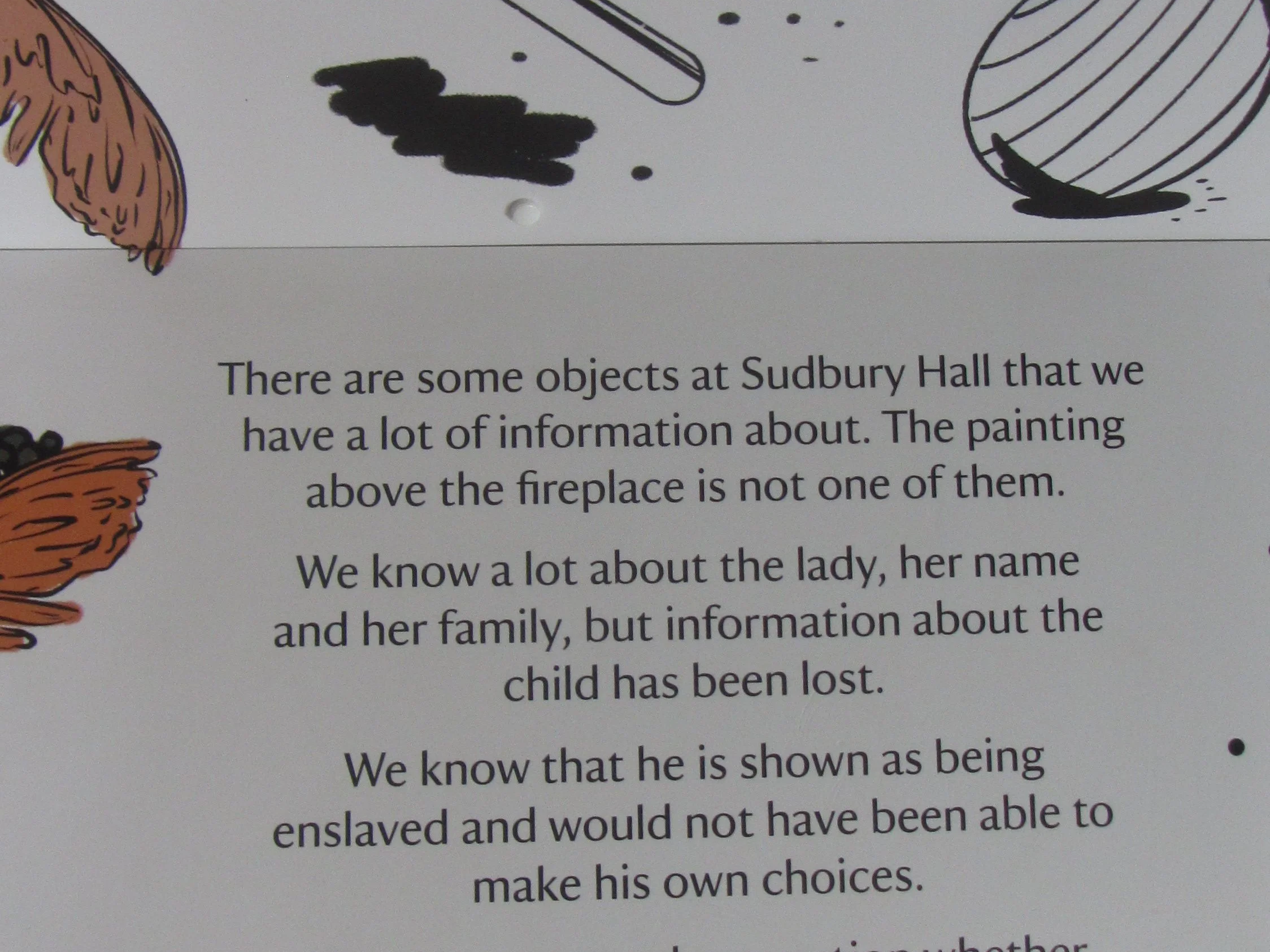
Why not stick to factual explanation and spare visitors the intrusive boards?
The National Trust cannot resist identity politics. In the next room there are child-size tables and chairs set out with paper and crayons. This portrait hangs over the fireplace, surrounded by amazingly lifelike birds, fish, fruit and flowers carved in limewood by the famous carver Grinling Gibbons (1648–1721). It portrays a white aristocratic woman beside a young black servant. It is common knowledge that black servants in aristocratic portraits were a sign of the aristocrat’s wealth, opulence and social status. The National Trust seems to have taken a rather odd approach to addressing the portrait. The large notice displayed in the room does not present us with any objective information or facts about the art. If this is because there simply is none, that would be understandable. But no, the notice continues, ‘we know a lot about the lady, her name, and her family, but information about the child has been lost’. Firstly, if it is true that you know a lot about the lady, why not say something about her? Perhaps the logic goes, if we don’t have information on the boy, then we are not saying anything about the woman either. After this the notice becomes unnecessarily political : ‘We know that he is shown as enslaved and would not have been able to make his own choices’. Clearly any servant or slave, especially a young one at that, would not have been able to make his or her own choices. This goes without saying. Where there are portraits of white servants or slaves, I don’t see notices that highlight their limited autonomy, because such a thing is a given by virtue of their social status. Rather than speculate as to what we don’t know, drawing out somewhat obvious implications of the boy’s social status, why not just give information on what actually is known? Informing us about the lady’s identity and background allows viewers to form their own interpretations of the boy and what he represented in society. Notices and labels are supposed to leave space for the audience to form their own judgements, interpretations and opinions. Let us make up our own minds! There is also a piece of contemporary art displayed in the room which seems to be a modern-day visual interpretation of the origins of the boy. Again, it seems to be based on someone else’s subjective view on who he was and where he originated. Again, this prejudges the reactions of viewers; it steers viewers towards forming an understanding of the boy on the basis of the subjective interpretation of another.
A Second Trip to Sudbury
I took a second trip to Sudbury so that I could experience it without the Christmas festivities. Since, on the previous occasion, I was disappointed by the lack of information about the history of the Hall, I met up with a lovely lady who not only knows the history of the house, but is part of the hall’s history. She was the granddaughter of the Head Gardener to the 9th Lord Vernon and was brought up in a house very near the Hall. Because of this connection between her grandparents and the 9th Lord and Lady Vernon, she spent many long hours as the playmate of the 9th Lord and Lady's granddaughter, who was the same age, in the house, the walled gardens and by the lakeside. She knew the the hall as a family home for 20 years before the death of the 9th Lord Vernon in 1963. Her mother maintained close ties with the family after 1963, having grown up with and built a strong friendship with the 10th Lord Vernon. It was a privilege to learn so much about the house, its history, stories behind various portraits and artefacts, and anecdotes about the family. I was inspired and during that tour, I could visualise everything she was telling me. By the end of the tour, not only was I moved and inspired, but I also regretted that others do not get to have the experience that I did that day touring the house with someone who was such a special part of Sudbury’s history.
Cringe Continued
Sudbury Hall is being drowned in child trivia and becoming something that it clearly is not and has never been. The house as it once was is not the children’s playground that it currently is; it may as well be construed as ceasing to exist. The Trust has completely transformed one of the gardens. Transformation is the antonym of preservation, something that is no longer at the centre of the Trust’s strategy. Why visit a house that has been changed and altered so much that we aren’t even witnessing heritage anymore, we can no longer see what was once seen before the National Trust took on the house.
The library looked more like a set for a Harry Potter film than a place where you read books, not that it is particularly magical. Pieces of folded paper suspended around the room mimic, I guess, magical flying pieces of paper, for the amusement of children. As an adult, albeit a young one, I think it looks ridiculous and takes away from the beautiful room.
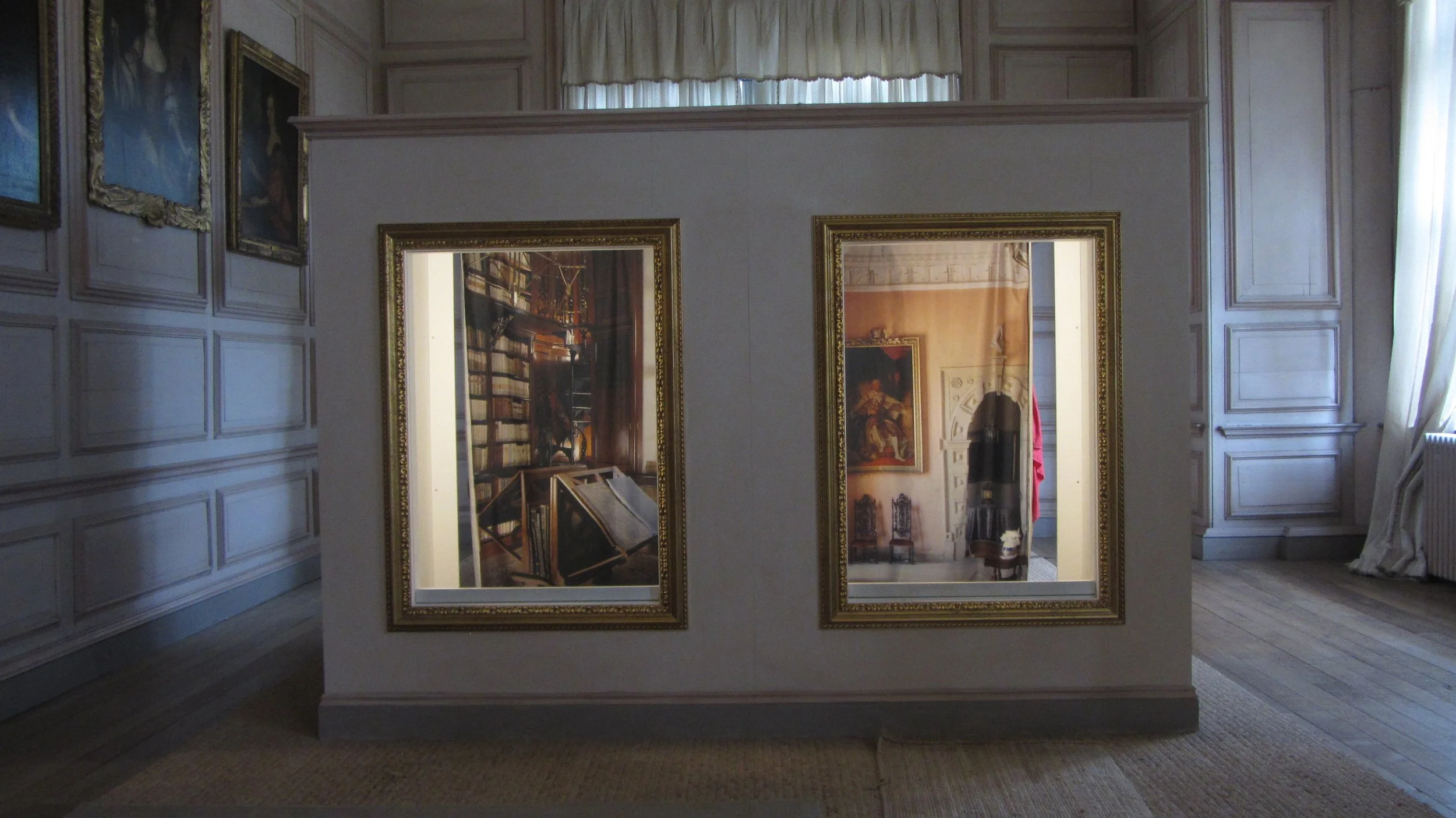
A dressing-up booth in the Long Gallery
The Long Gallery has gone from bad to worse. Not only were the portraits with their cringe-inducing speech bubbles still up, but the room was packed with even more toys than at Christmas. At the end of the Long Gallery stands a pop-up, but seemingly permanent, dressing-up room which has the effect of transforming the magnificent seventeenth-century room into something ordinary. It also blocks the light from a large window at the far end, which was surely designed to illuminate the rich interior of the room.
The Vernons as down-to-earth aristocrats
My experience at Sudbury was rescued from absurdity by my fascinating guide. There were a number of things that she was able to draw my attention to, many of which are quite possibly unknown to the National Trust, or otherwise ignored due to a lack of interest.
The Vernons were quite unique aristocrats for their time. The 9th and 10th Lord Vernon in particular were humble and frugal men who adored their local community. My tour guide knew them both, as well as their wives and even their dogs! The reason why she was able to spend so much time in the hall was because the Vernons saw all of their workers as family. The lady told me how, as a child, she would run around the grand bedrooms of the house. She told me that Lord Vernon would turn the lake into the village ice-skating rink during winter. After checking the strength of the ice, everyone was welcome on his land to enjoy themselves. This tells us how much reciprocal trust the Vernons had in the Sudbury community. Sudbury Village formed a part of the Vernons’ estate and the Vernons used it to house many of their past and present workers and associated families in sanitary and comfortable conditions. These are some insights that are unknown to most visitors and will continue to be unknown if the National Trust remains uninterested in the people who could tell their stories.
The National Trust ignores the people who know Sudbury best
The lady has protested against the infantilisation of the house on many occasions, but no-one at the National Trust has paid any attention. She and the daughter of the 10th Lord Vernon are among the last people alive who experienced country house life at Sudbury, and yet the National Trust has shown no interest in their memories of the house. As this lady told me, the 10th Lord Vernon gave the house to the National Trust because he believed strongly that they would be able to protect its heritage, history and legacy. He believed in their vision and trusted them to carry it out. The lady said that if he had known that they would turn his legacy into a children’s playground, he would never have handed the property over. By trivialising the house the National Trust has broken faith with the family which gave it to be preserved for future generations, and with the community.
It is time for the National Trust to start respecting heritage again. Respecting heritage means respecting and hearing the people whose history is rooted in the house. I, and many visitors who are enthusiastic about heritage do not want to see the history of houses distorted by the lens of today’s concerns, or even worse, made trivial with toys. We are interested in learning about the Vernons, how they engaged with the Sudbury community, what the objects in the house meant to them, what was the thinking behind the designs and colours used to decorate the house, what the process of commissioning the art work was like, where the children were allowed to play in the house, what the Vernons’ relationship was with servants, what their interests were and why. These questions were only answered once I toured the house with the lovely lady. I left moved and inspired. If only other members of the National Trust could have such an experience.