National Trust blacklists volunteer who pointed out spelling mistakes
A volunteer tried to help correct the National Trust’s website but was ignored. The Telegraph reports:
The National Trust blacklisted a volunteer after he pointed out spelling mistakes on its website.
Andy Jones, 71, a volunteer at the trust for more than a decade, sent a dossier of thousands of misspellings and factual errors to the charity’s director-general in the hope that they would be corrected.
After sending a strongly worded complaint to his local branch, in which he criticised the trust’s director-general for not responding, he was told that his comments were “not in line with our organisational values” and was banned from volunteering at any of its sites.
His case is the latest example of the trust dismissing or suspending volunteers over claims that they do not meet its “culture” or “values”.
Earlier this year, more than a dozen volunteer gardeners on the Isle of Wight were suspended after managers claimed that some of their behaviour did not align with the trust’s “inclusive culture”.
The separate cases appear to be examples of the organisation’s pursuit of a progressive culture, which has included exploring properties’ links with slavery and colonialism and asking some staff to wear rainbow lanyards.
Responding to the cases highlighted by The Telegraph, Restore Trust, a pressure group comprised of members and supporters of the organisation, accused the charity of “disciplining or sacking volunteers for their opinions”.
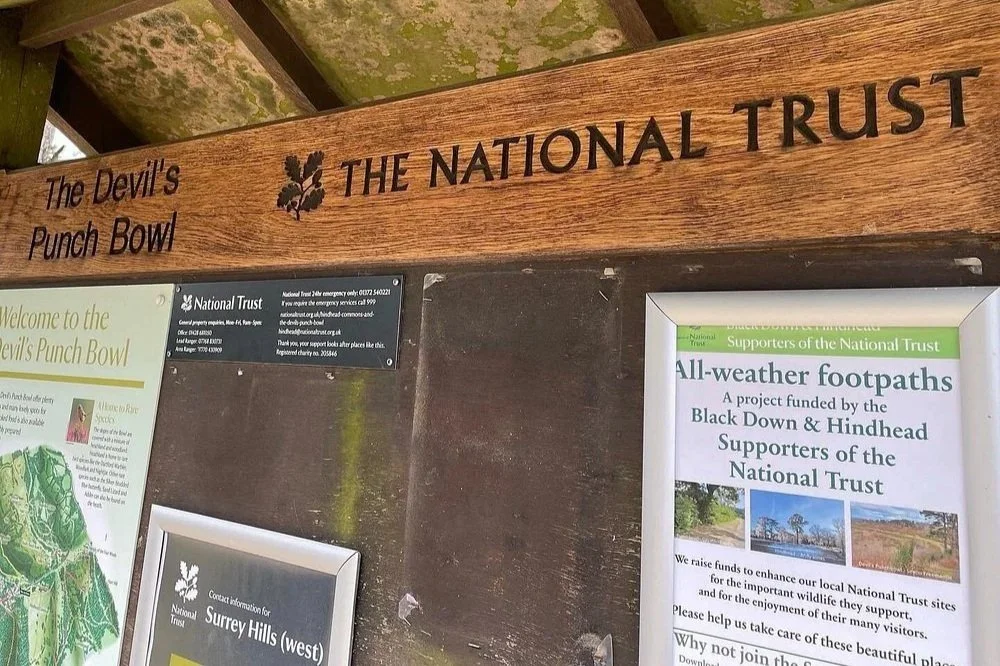
Mr Jones volunteered for the National Trust for 14 years, first at the Woolbeding estate, in West Sussex, and later at Hindhead Commons and the Devil’s Punch Bowl in the Surrey Hills. His roles included everything from gardening and burning waste to dealing with membership queries and offering guidance to visitors on walks.
Last year, on his own initiative, he reviewed the trust’s web presence and created a dossier of the mistakes.
These ranged from typos such as “toliets” and “permanant” and grammatical errors such as “take a peak” to misspelling the name of the pre-Raphaelite artist Lucy Madox Brown as Maddox Brown.
In November 2024, he sent the dossier to Hilary McGrady, the trust’s director-general, who is from Northern Ireland, in a politely worded email asking if she would “be so kind as to forward this to whomsoever has the authority and resources to address these errors”. Ms McGrady was awarded a CBE for “services to heritage” in the King’s New Year Honours.
Mr Jones received no reply and sent a follow-up email in January 2025, part of which said: “I sincerely hope my work is helpful to the National Trust.” Again, he received no response.
Frustrated, he quit as a volunteer at his local site. He sent a strongly worded email to his manager, part of which said: “Still no reply, acknowledgement, let alone thanks from the Oirish [sic] Dame on over 400 hours spent on her crappy not fit for purpose webs--te.”
A manager responded: “I was really disappointed by the language contained within your email. These comments are not in line with our organisational values.”
She said his relationship with the trust had “irreversibly broken down” and that “we will no longer consider you for any future volunteer positions at any of our places”.
Mr Jones admitted to The Telegraph that his comments were not appropriate but claimed that he was stressed at the time as he was suffering from stage-two prostate cancer.
He said: “I think the concept of the National Trust is a brilliant one, and it has achieved an astonishing amount in the 130 or so years it has been running. It’s simply that its senior management team are well past their ‘use by’ date and the organisation needs to be completely re-invented by a new, young, vibrant leadership that brings it kicking and screaming into the 21st century.”
A trust spokesman said: “We can say that no-one would be told they were no longer welcome as a volunteer simply for pointing out grammatical errors on a website and this would not lead to relationship breakdown. Relationship breakdown tends to occur after a series of incidents.”
Mr Jones’s case has similarities to that of 13 volunteer gardeners who spent decades working in the grounds of Mottistone Manor, on the Isle of Wight, before they were told in June that their work had been paused indefinitely.
Managers said there had been “instances of behaviour, language, or attitude that do not reflect the respectful and inclusive culture we strive for”. However, they gave no examples of this alleged behaviour.
Graham Field, 76, who acted as a spokesman for the gardeners at the time, said: “With a cold and dismissive click of a send button, over 100 years of gardening skill, site-specific knowledge and hard work were lost to the Trust.”
A spokesman for Restore Trust said: “The National Trust talks a great deal about being inclusive and welcoming, but many volunteers feel excluded and unwelcome. While diversity is high on the charity’s agenda, this does not appear to include diversity of point of view.”
A trust spokesman said: “The National Trust works with tens of thousands of volunteers and we are deeply grateful for the enormous contribution they make. Occasionally there will be disputes and even breakdowns in relationships, and we provide all the support we can through agreed processes with the individuals concerned.
“We can not address private individuals’ details or records via a newspaper, regardless of what any individual shares or claims, because we have a legal duty of confidentiality.”